On the western edge of campus, there sits a shiny, spaceship-like geometric metal facade, thoughtfully designed to both compliment and contrast the landscape around it (which, in this case, is a 16,000-year-old prehistoric sand dune and a grove of towering pines), and to hold within it both nostalgia for a storied past, and aspiration for an exciting future.
In the first two minutes of remarks delivered at the dedication ceremony for this new campus building on November 1, 1974, two people—the late, great Terry Braverman, who emceed the event, and Burt Smith, the athletic director who had helped shepherd the project—referred to the facility as “beautiful.”
And it was.
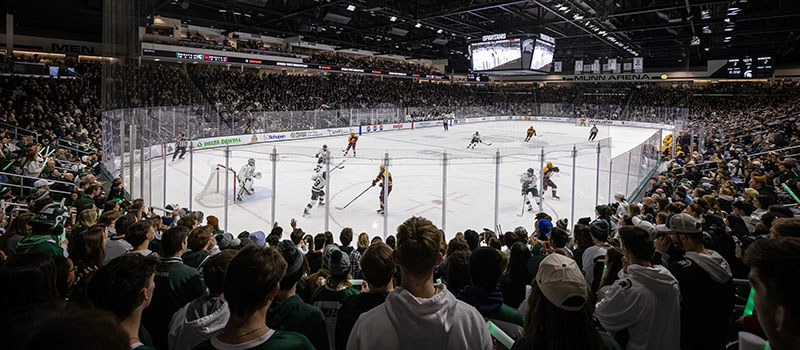
The beautiful building our campus celebrated that day was Munn Ice Arena. Now, half a century later and thanks to Spartan generosity, it’s entering a whole new era.
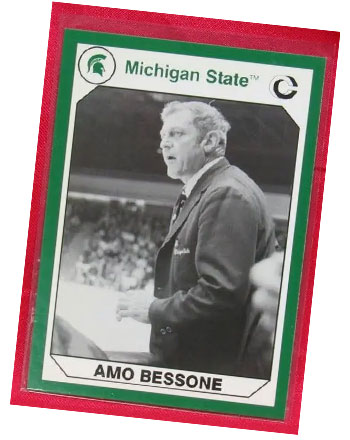
By the early 1970s, the men’s hockey team—and its rabid fanbase—had outgrown their arena space in Demonstration Hall. With a national championship (1966) and an impressive streak of winning seasons under head coach Amo Bessone, a dedicated hockey facility wasn’t just needed to keep the program going and growing. It was earned.
At the time of its construction, Munn Ice Arena was considered one of the finest college rinks in the country. It was modern, had all the amenities a hockey player, coach or fan could want, and that meant great athletes, great staff and sellout crowds flocked to it.
Two National Championship teams have been built there. Between 1985 and 2004, Munn sold out 323 consecutive regular-season games—filled to the rafters on any given weekend with joyful noise, backed by a live soundtrack from the Spartan Brass.
Prior to Munn’s construction, Coach Bessone went on record to say that hockey’s original venue in Demonstration Hall was “the only hockey rink that can guarantee everyone a bad seat.”
Decades later, a random reviewer on Trip Advisor—who could’ve said anything under the shroud of anonymity offered by the internet—unknowingly bookended Bessone’s lambasting with this succinct review of Munn: “Their arena is very modern, and there is not a bad seat in the house.”
RENOVATING FOR A RENAISSANCE
University athletics are often characterized as the “front porch” of the school itself. Sports welcome people in through what might be their first—or even their only—experience of campus.
Making that experience special for fans and visitors is important.
It’s also important for the people the fans are cheering on: the players, coaches and staff.
Before a student-athlete begins to compete for a university, the universities are competing for the student-athlete. A lot more goes into a young hockey player’s (or any athlete’s) decision about where to attend college than whether the school in question has fancy facilities.
But fancy facilities are a factor, and by the late 2000s, the beautiful, modern Munn of 1974 was starting to look a little nostalgic. A great place to high-five your friends and throw newspaper confetti after the goal horn on a Friday night? Absolutely. But maybe not the ideal place for aspiring pros to develop their game on the national stage.
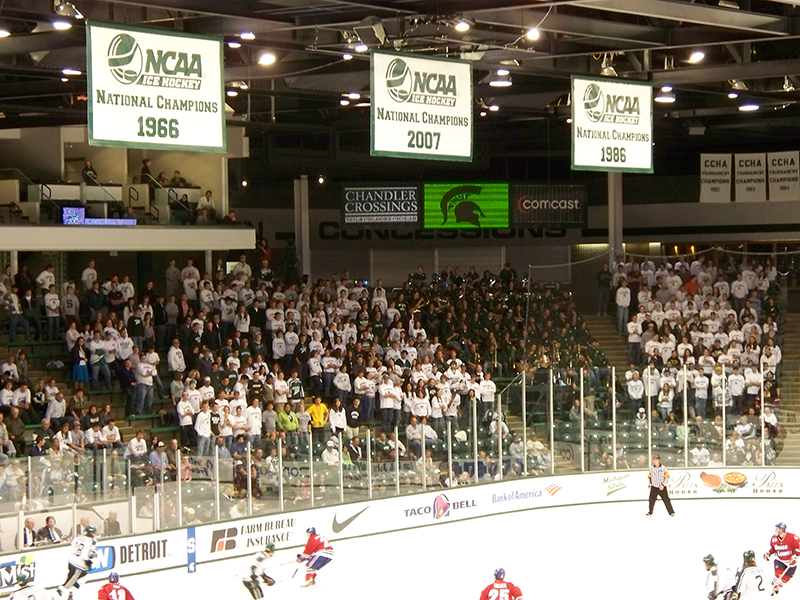
While it still drew raucous crowds night after night, Munn had become disconnected from the state-of-the-art training facilities and resources the modern game demanded.
Munn received several notable updates in the decades since its opening. A new refrigeration system and an expanded press box in the ’80s; the four-sided scoreboard over center-ice in the ’90s; accessibility updates and suite seating in the 2000s.
These were all timely, necessary changes, though they didn’t change the fact that:
A) Munn is the second-oldest hockey venue in the Big Ten (second only to Yost in Ann Arbor),
B) from the outside, it looked largely untouched compared to its two closest campus counterparts: the Breslin Center and the Duffy Daugherty Building, and
C) there was momentum coming off Spartan Hockey’s 2007 National Championship title—excitement that could lead to funding opportunities and buy-in for a major renovation.
It was time for the beautiful building to get re-beautified for a new century.
THE PEOPLE MAKE THE PLACE
Even at a university, where facilities and success are closely intertwined, prestige can take root in the humblest of places.
Take MSU’s Packaging Building and its first-and-best-in-the-nation School of Packaging, for example.
For decades, the building’s cramped office wing and aging lab spaces were home to the teachers, researchers and leaders whose collective discoveries and accomplishments were steering the direction of the entire packaging industry.
Furthermore, the faculty and staff of the School of Packaging hold the monumental responsibility of educating a considerable percentage of packaging leaders of the future: 40% of the nation’s industry professionals come from MSU, and no other school in the country offers a packaging Ph.D. program.
Ever proud of their roots, Packaging alums were the first to step up when they heard about the fundraising campaign to renovate the building.
Chuck Frasier was one of them. The 1970 School of Packaging grad, along with his wife Jackie, made a lead gift of $1.5 million to the project in 2019. (To bring their story full-circle, the couple later made the final gift to the renovation campaign—pushing it past the goal and enabling construction to begin.) Their leadership and belief in the project set off a groundswell of generosity.
The result? A refreshed space, where the impact of generations of packaging alums and industry partners is seen and felt around every corner, and where the gifts keep giving. The future is so bright for the program, that even more upgrades are on the horizon. A phase two project is expected to break ground soon.
In the same way Chuck and Jackie Frasier and fellow Packaging alums championed their beloved program, MSU Hockey alum Gary Harpell championed his beloved Munn.
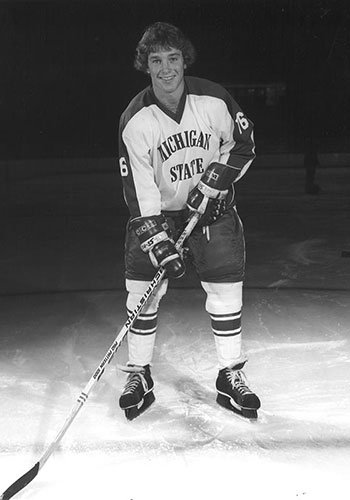
A freshman walk-on who played from 1978–1982, Gary Harpell fell in love with Munn as an 18-year-old, and he credits his days wearing the Spartan jersey as formative to the person he is today.
He and his wife Joanne gave $1.5 million to the Munn renovation project, and continue to support the hockey program and other favorite causes on campus. But they also gave something that was equally valuable to Gary’s beloved college rink: time.
Gary was part of an active group of former Spartan Hockey players who reached out to their networks to drum up enthusiasm and support for the project. It turns out, a lot of those contacts had a formative connection and wanted to leave their mark.
“I am so proud of the contributions we made,” Gary said. As his involvement grew, so, too, did the size of the gift he and Joanne made, and now, he sees his impact—and the impact of his friends and former teammates—in the building and the program.
“I am amazed at how functional and beautiful it turned out. I love walking through the rink. Coach Nightingale is constantly adding plaques, murals and paintings that tell the history of MSU Hockey and connect the past with the present. It’s important that MSU Hockey alumni feel a strong connection to the team’s success, as they laid the foundation that today’s team is built on.”
OUT FROM UNDERGROUND
There is another place on campus where incredible work flourished in inadequate space for decades before a philanthropically funded renovation improved the working and learning environment: the Stephen O. Murray and Keelung Hong Special Collections, at the MSU Main Library.
The collections, which comprise 450,000 printed works and other ephemera, are worth an estimated $155 million, though no amount could truly replace many of these ancient and one-of-a-kind items. Until 2024, they were housed in a space in the basement of the Main Library.
Plans were already underway for a $13.8 million renovation project that would move Special Collections and its staff to a more practical, above-ground location, when Dr. Keelung Hong approached MSU in 2019 with a gift.
His late spouse Dr. Stephen O. Murray, an MSU alum of the James Madison College, was a sociologist, anthropologist and comparative historian who loved research. Throughout his career, Stephen turned to Special Collections to study pieces that informed his work, so it felt extra meaningful to Keelung that those papers and research materials become a part of the collection, too.
But his husband’s life’s work was only part of Keelung Hong’s offer.
The other part? A generous gift of $5 million that forever tied Dr. Murray and Dr. Hong’s names to the new light-filled home for Special Collections on the third floor of the library’s east wing.
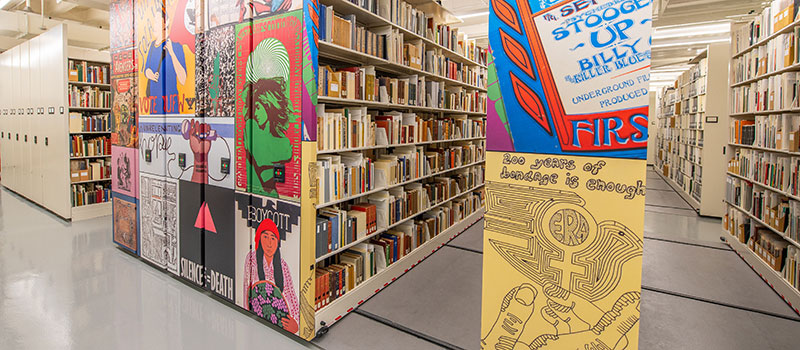
There, the collection is safe from the Red Cedar flood zone. It’s equipped with the climate control and fire suppression capabilities required by materials of this caliber. And it’s welcoming and user-friendly for students, faculty and visitors, who travel from miles around to inform their research and satisfy their curiosity.
Most importantly, for the first time in Special Collections’ history, the busy, brilliant librarians, archivists and conservators charged with the collection’s care—who had not previously been grouped together in a central location—are finally co-located in a space that’s truly their own.
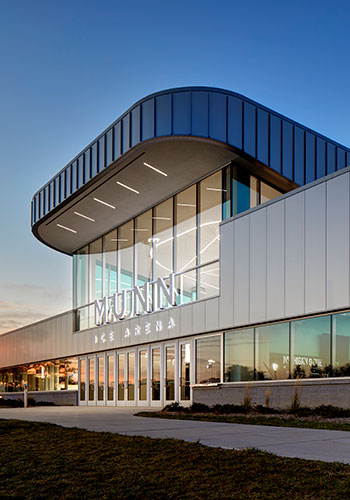
If the glass walls of the Stephen O. Murray and Keelung Hong Special Collections—which reveal brightly-decorated bookshelves of treasures—were a welcome change for those who work with its contents on a daily, the glass walls of Munn Ice Arena’s new “front door” are an equally welcome change for anybody who has ever approached the building and wondered, “How do I even get in?”
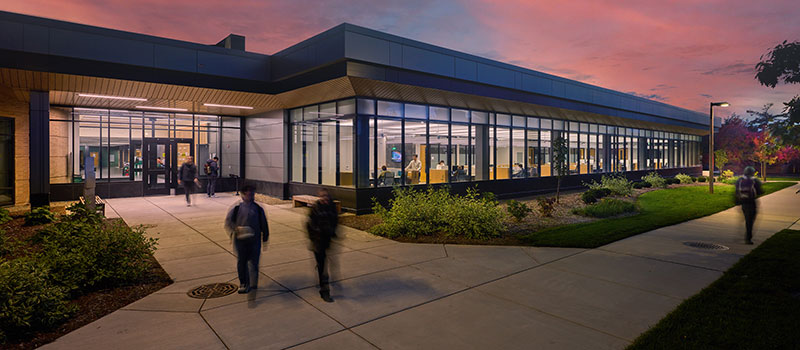
The renovation turned Munn’s south entrance—arguably its most prominent, with a sweeping, panoramic view of Munn Field and campus’s other iconic sports venues—into an open, high-ceilinged vestibule where fans walk down memory lane through the Ron Mason Hall of History on their way to the concourse.
The remainder of the 35,000 square foot addition made room to bring offices, conference rooms and administrative spaces out of the arena’s dark underbelly and onto the main level. It also added a state-of-the-art weight room—a first in Munn’s history.
KEEPING UP WITH CAMPUS NEEDS
Universities use space differently now than they did in the 1950s, ’60s, and ’70s. New technologies for instruction and research are outgrowing the capabilities of old classrooms and laboratories. Teaching methodologies are evolving. Industries are looking for different skill sets in future employees. And at the heart of it all, a great deal of thought and care is being put into how today’s students live and learn best.
In the last decade, both the College of Music and the Eli Broad College of Business underwent transformative, philanthropically funded renovations to address and future-proof their facilities’ capacity to meet the needs of students, faculty and their respective industries.
The Billman Music Pavilion, named in honor of a gift from alumnus Dr. James K. Billman Jr., added 37,000 square feet to its existing structures, which also underwent extensive renovations. It resulted in 45 new practice rooms, technological enhancements for the lecture halls and studio spaces, long-needed climate control, and welcoming gathering spaces for the thousands of students who participate in classes in the building.
No detail was overlooked—down to the thickness of the floors, the shape and height of rooms, and what materials were used on and between the walls, all of which impact the most important component of any musician’s work: sound.
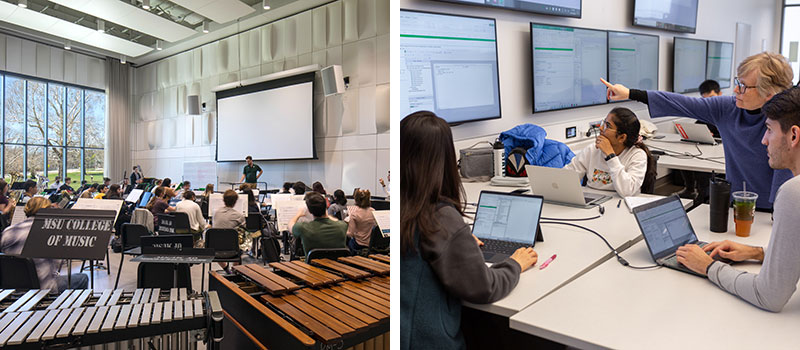
At the Eli Broad College of Business’s new Edward J. Minskoff Pavilion there was similar attention to detail, to ensure the space met—and had the capacity to exceed—the educational and extracurricular needs of a 21st century student.
Flexible classroom spaces spark conversation and collaboration; gathering areas are tailor-made for networking or meetings; and an entire suite, the Russell Palmer Career Management Center, is devoted to career advising and engagement with companies that seek to recruit Spartan business majors.
That same level of care was also built into Munn’s renovation.
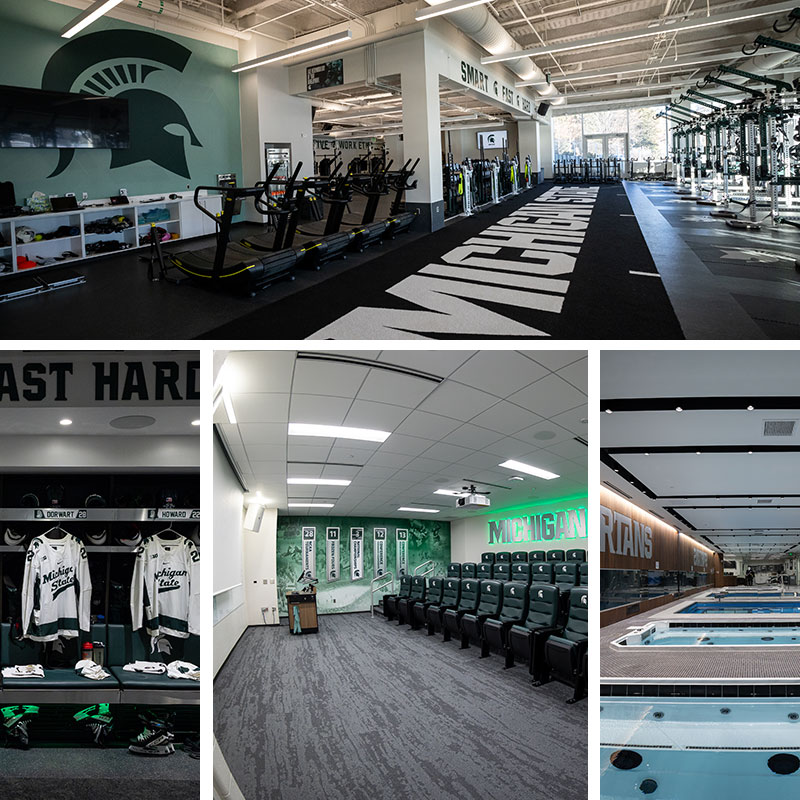
The expansion made space for state-of-the-art athlete amenities: a space for studying, a shooting room built to withstand the hardest slapshots, an area equipped with underwater treadmills and a hydrotherapy pool, and a theater-style room for reviewing game tape.
To top it off, a brand-new home locker room, custom designed for their needs, including skate hooks placed directly in front of a built-in ventilation system to help dry out sweaty skates.
These renovations—every single one of them—could not have been made on such a grand scale without donor support. Generosity was the difference between simply making necessary repairs to keep an old building in working order, and making an old building into something beautiful and functional for a new century.
HOME OF CHAMPIONS
From the outside looking in, it’s easy to wonder whether a fancy building filled with fancy things actually moves the needle in education, success and excellence.
To answer that question on behalf of the programs where such progress may not be so obvious to the casual observer, look no further than what the hockey program has done since 2022, when MSU Athletics officially cut a ribbon, for the second time, on beautiful Munn Ice Arena.
They welcomed a new coaching staff, headed up by Adam Nightingale, himself a passionate alum of the Spartan hockey program.
They’ve enjoyed a string of successful recruiting seasons, stacking the team with talented young players—some of whom have already been drafted by NHL teams.
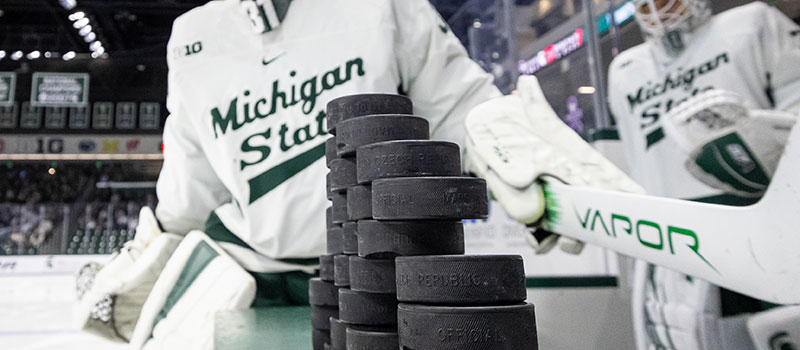
The Spartans have won back-to-back Big Ten season and tournament championship titles, and made back-to-back trips to the NCAA tournament for the first time in more than ten years.
Season tickets and individual home games have sold out in such dramatic fashion that, last season, local fans from East Lansing had an easier time getting tickets to watch the Spartans play an outdoor game at Wrigley Field in Chicago than they did getting into Munn.
Inside every beloved old space on campus that has been refreshed or renewed over the last decade there are people doing extraordinary things. Things that feel like championship victories and truly create meaningful change—not only for their school, but also the world.
FUTURES BUILT
Late last winter, right around the time the hockey team was gearing up for postseason play, MSU launched its most ambitious campaign yet: Uncommon Will, Far Better World.
The goal? Raise $4 billion. The desired outcome? More scholarships and programmatic support to help students have the best Spartan experience possible. Support for faculty research, and the large, interdisciplinary projects that have the potential to solve the world’s biggest challenges. And, of course, funding for buildings, because without buildings, where will all the students and researchers (and student-athletes) do their thing?
If the projects on the horizon, which include, among others, a major facelift at Spartan Stadium and a multi-story facility to support technological and digital innovation across six colleges, are met with as much enthusiasm as the projects in the rearview, the future of campus facilities is incredibly bright, and, word has it, there won’t be a bad seat in the house.