Under flashing neon lights and the steady whir of claw machines, a young woman slipped through the rows at Klawsome and stepped up to the front desk, asking to speak with the arcade's owner.
She introduced herself as Issa Marudo, a junior at Michigan State University and a representative of the Pilipino American Student Society (PASS). She was greeted by Agnes Filipowski, '07, who co-owns the business with her husband, Michal, '08.
Marudo had heard about Klawsome's recent grand opening in Novi and its ties to Filipino culture. She hadn’t known that its owners were proud Spartans themselves, and the longer the two women talked, the more serendipitous their meeting seemed.
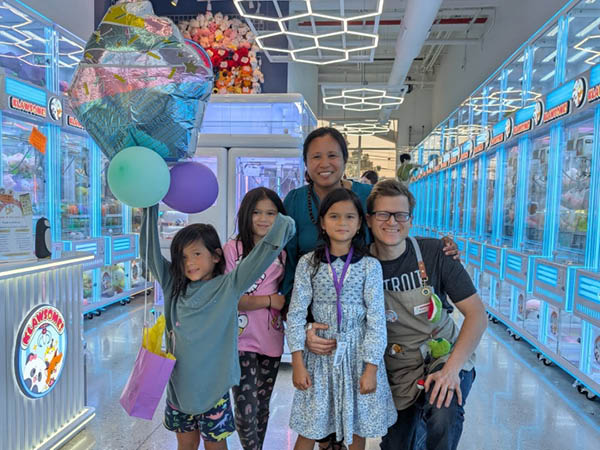
Over the past few years, Agnes has been on a journey to reconnect with her Filipina identity. Growing up, her parents pushed for assimilation after emigrating from the Philippines. Agnes never learned the Tagalog language, never developed a deep connection to her roots. That’s just how it was.
“That story is common among my generation," Agnes said. "I didn’t grow up with as much of that pride. ... It’s not that I avoided it. It just wasn’t a priority or interest to me.”
Agnes was familiar with PASS. As a student at MSU, she knew other Filipino students and was invited to events. But she never found time to get involved, which she regrets today. After graduating, she and Michal moved often, lived abroad and started their own family, awakening a desire to reclaim her heritage.
Klawsome is steeped in Filipino influence, from the look and feel of the arcade to its carefully crafted logo. The design features playful avatars of the couple’s three daughters — a clever fox, a gentle panda and a fun-loving cat — along with a subtle nod to the Philippine flag’s eight-rayed sun.
Even the name pays homage. The letter “C” does not exist in the Tagalog alphabet, replaced instead with a “K.”
In August 2025, the clawcade was one of the first retailers to open at Sakura Novi, an Asian-themed mixed-use development. “This made sense here,” Agnes said. “We wouldn’t have gone into this business if it had not been for the focus on the Asian American community. To be surrounded by other Asian American businesses like this really felt like home.”
That sense of belonging matters for a business built on family. Michal had long dreamed of starting his own business, and now he couldn’t imagine one that didn’t include his wife and children. If they were going to do this, they were going to do it together.
“We all have a purpose and a place in it,” Agnes said.
Once upon a time
Michal and Agnes may have the quintessential Spartan love story.
They met as undergrads at the St. John Student Center, a Catholic parish serving students, faculty and staff at MSU. Naturally, they returned to East Lansing for their engagement. Michal planned a whirlwind campus-wide scavenger hunt that reconnected them with favorite landmarks — Spartan Stadium, Beal Botanical Garden, Cedar Village, the rooftop at El Azteco and more — before ending back at St. John’s, where he proposed.
“The proposal was really phenomenal. I can’t think of any other proposal like it,” Agnes said. “Michal doesn’t do anything small. Everything is always a bigger, grandiose plan.”
They returned for their engagement photos and then again, in 2011, for their wedding at St. John’s and the Kellogg Center. Even Sparty made an appearance. “That’s how much we love Michigan State,” Agnes said.
True to that “bigger, grandiose” spirit, the couple took a bold step years later, moving to South Korea after Michal completed his MBA at Virginia. Their first two daughters were born there, and it was where they first encountered claw machine arcades, a staple across Asia.
“They’re everywhere. It’s like Starbucks here,” Michal said. “Some have common everyday items. It’s like shopping, but you’re winning to shop. It’s something that only started getting popular here a couple years ago. And the kids loved it immediately.”
The Filipowskis discovered their first clawcade in the U.S. while visiting Agnes’s mother in Las Vegas. Accustomed to the standard machines found in malls or retail vestibules, Agnes expected a gimmick. “But we won. We won a lot,” she said. “After that, because we had so much fun, we started looking for more.”
They found them in cities across North America — Philadelphia, Washington, D.C., New York City, Toronto, Montreal, Austin — and along the way, those visits became informal, and then formal, market research.

“The kids just loved winning bags full of plushies. You actually win a lot. That’s the fun of it,” Michal said. “They fell in love with the plushies, and I’m a finance major, so I fell in love with the margins.”
Tips and tricks
Klawsome houses 45 claw machines, including 16 minis, and draws more than 6,000 players each month in a vibrant 1,300-square-foot arcade. But the goal isn’t a one-off win. It’s something closer to a haul.
“We want to create people who take joy in winning bags full of plushies and want to do it again and want to do it every month,” Michal said. “We have a lot of regular customers.”
Though there’s always an element of luck, skill matters too. The machines aren’t set to only pay out after a certain number of plays. The weight, size and material of the prizes are factored into the claw’s grip, but success isn’t random.
“Your skill, your depth perception, your experience with the claw actually affects your ability to win,” Michal said. “You’ll see your skill and work actually paying off. You’re going to win significantly.”
It’s also a more hands-on experience than most arcades. Staff circulates the floor, offering tips, asking about favorite characters and guiding the player experience. Some minis are even “play until you win,” guaranteeing a prize. If someone struggles, staff will reposition a plush, build a “plushie pyramid,” or help nudge a prize closer to the chute.
Larger and more rare prizes are kept behind the counter. Rack up enough wins in the machines and your haul can be traded up for something bigger and better.
“Just ask us,” Michal said. “We want people leaving with what they want.”
Michal and Agnes (and their kids) have become skilled players themselves and freely share advice: Check the machine from multiple angles, especially the sides, to line up the claw. Almost everyone needs to push the claw back another half-inch, Michal said. Aim for the center of gravity, whether that’s the head or body, and look for prizes that sit above the pile. Or, as Agnes suggests, go for the easier grab first and then ask to trade within the machine for the one you really want.
Never too late
When Agnes’s father was diagnosed with esophageal cancer, the family moved back from Korea to the U.S. to be by his side. He passed away in 2018. The loss forced Agnes to reevaluate her own life. “Between that loss, having kids and not wanting to have a watered-down heritage, it made me come back to my roots,” she said.
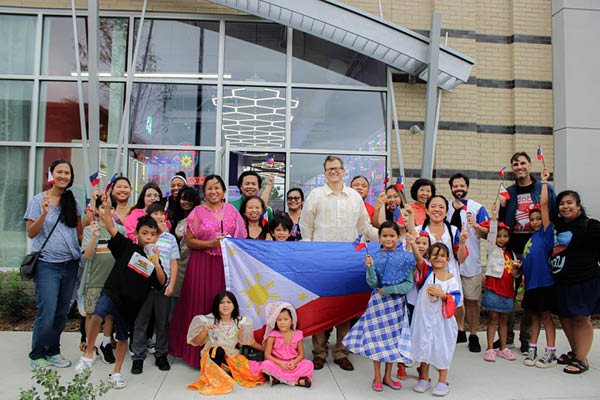
The couple’s children are now enrolled in a Filipino cultural school hosted by the Philippine American Cultural Center of Michigan. They are learning Tagalog, Philippine history, traditions, music and dance. Agnes is learning right alongside them.
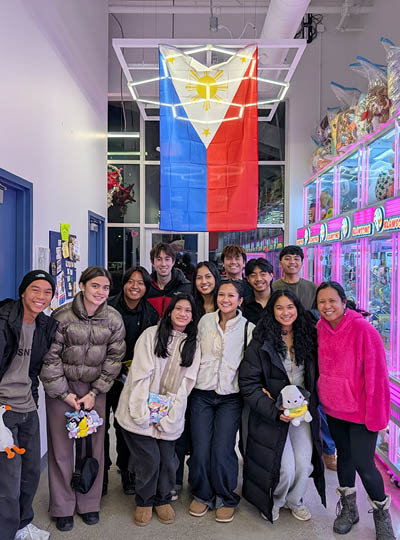
Spartans from PASS have volunteered at the school, building connections with the younger students while deepening their own. And earlier this year, Marudo helped organize a PASS trip to Klawsome. Everybody left with a plush, and Agnes with something more — a connection two decades in the making. There is a budding relationship between PASS and Klawsome that Agnes is keen to explore.
It’s never too late.
“I wish I had been involved back then, but now it’s part of my story,” she said. “My kids know about it, and now they are growing up with that cultural awareness and celebration that I didn’t have.”
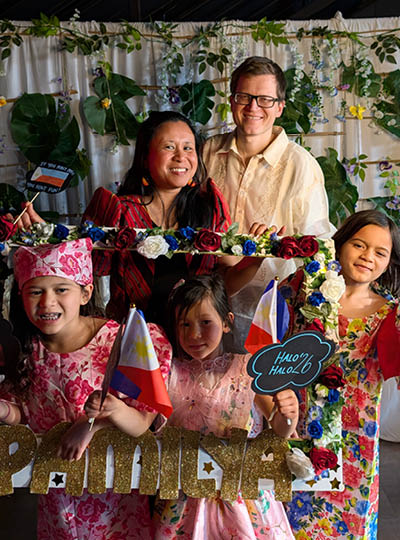
On March 21, Klawsome co-sponsored Halo Halo 2026, an annual PASS cultural showcase at Michigan State. Agnes and Michal attended with their children, enjoying classic Filipino food and performances, including tinikling, a traditional dance where performers step in and out of rhythmically clapped bamboo poles.
“Our kids had a blast watching that,” Agnes said. “They’re learning tinikling in their Filipino school, but this was much more advanced. They’re so much faster, and they had a modern take on it. It was super inspirational for our kids to see. That kind of reassurance is inspirational.”