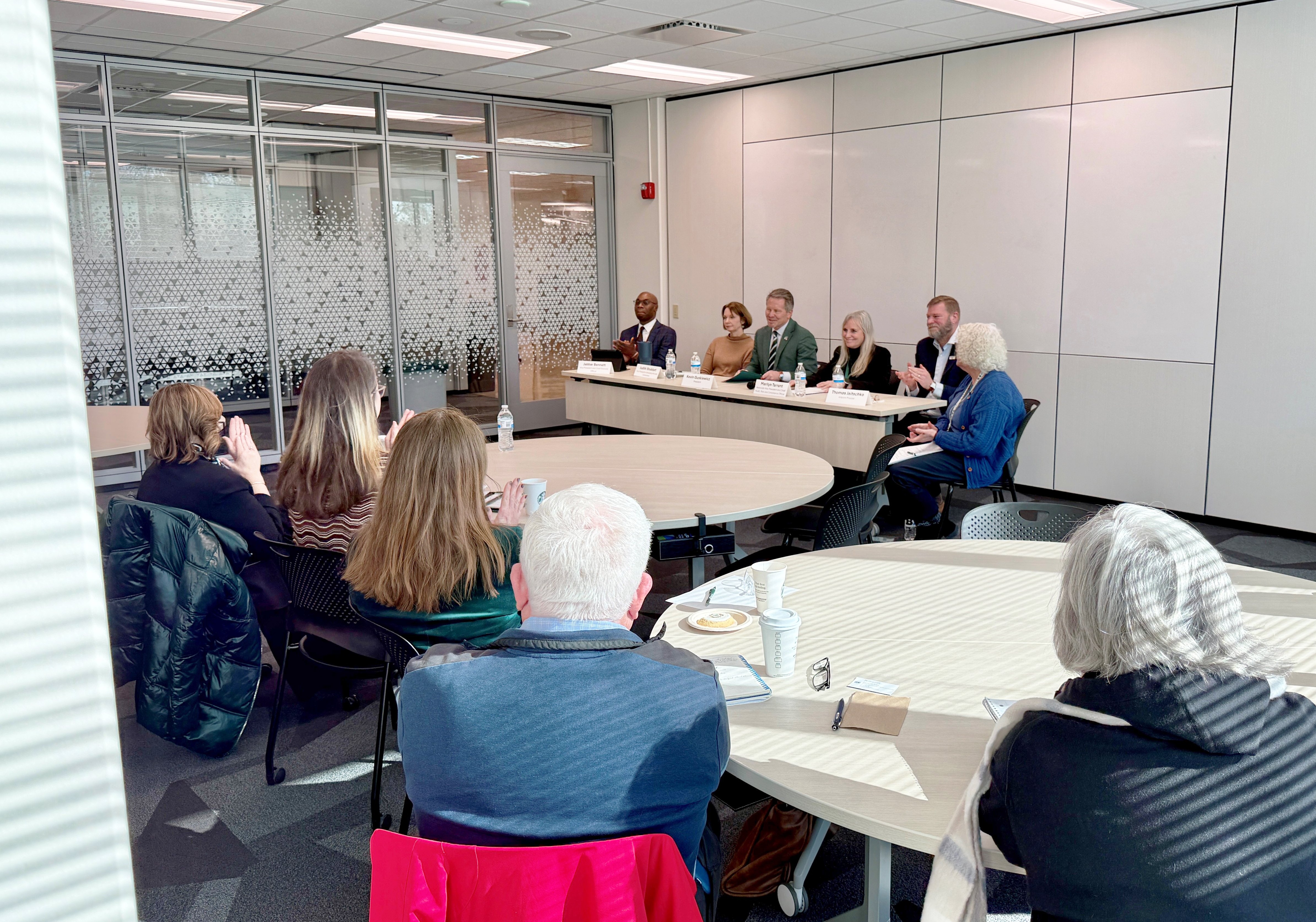
Nestled into a second-floor training room in the west wing of the MSU Library, a panel of Michigan State executive leadership gathered shoulder to shoulder for the university's first annual Ethics Week in February 2025.
Sitting center was President Kevin M. Guskiewicz, less than a year into his tenure, who had pushed to make this day possible. On his right sat Vice President and Chief Diversity Officer Jabbar Bennett and Vice Provost for University Arts and Collections Judith Stoddart. On his left was Associate Vice President and Chief Audit, Risk and Compliance Officer Marilyn Tarrant and Interim Provost Thomas Jeitschko.
The Ethics Institute aims to position MSU as a national leader in ethics with a values-driven approach to responsible research, education and community engagement. In his investiture address in late 2024, President Guskiewicz heralded it as “the only such institute in the state to move beyond its educational aspects to address institutional transformation—calling on all of us to model ethics and live our values in an ethical way.”
In joining the leadership panel for the inaugural Ethics Week, he affirmed his commitment to the campus-wide initiative, guiding a discussion on leadership, the values inherent to MSU and his vision for the future.
During the panel, President Guskiewicz declared that “great institutions like Michigan State are centered around the people.” He emphasized that our collective values, shared governance and individuality are powerful forces for progress, but that the “healthy tension” between those voices requires a moral heading to advance to the common good.
“If there’s not a healthy tension, then you’re going to be a status quo university. One of the things I love about Michigan State is that we are not status quo,” he said. Adding later, “We have to be sure that ethics is woven into the fabric of this place. I think it is, but we have to amplify it. We can do better.”
People and purpose
The Ethics Institute emerged at a pivotal moment. As the challenges shaping our world grow more complex, from artificial intelligence and data privacy to global health, journalism, sustainability and civic engagement, people are seeking institutions they can trust and leaders who act with integrity.
Bree Holtz, a professor in the Department of Advertising & Public Relations and Director of the Ethics Institute, along with Assistant Director Anastasia Lesage, are working closely with staff and students to better understand existing ethical challenges across campus and identify where additional support is needed.
The Institute is designed as a connective hub, working alongside established centers such as the Kelley Institute of Ethics in the College of Law, the Center for Bioethics and Social Justice in the College of Human Medicine, and the Center for Ethical and Socially Responsible Leadership in the Broad College of Business.
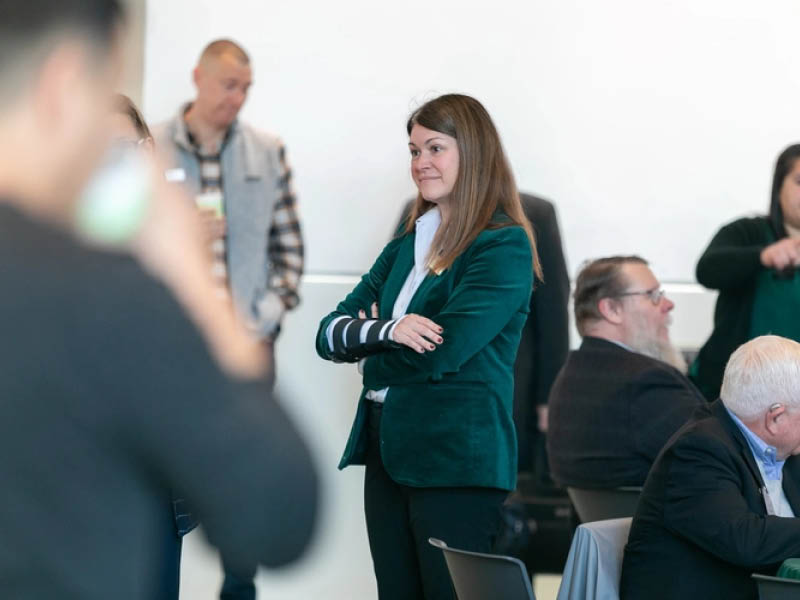
Ethics is already deeply embedded in MSU’s curriculum, with more than 300 courses each academic year engaging students across multiple disciplines and colleges. Part of the goal of the Ethics Institute is to expand these efforts while developing new endeavors that put ethics at the heart of the MSU experience.
“We want to be connectors that will elevate this conversation across campus,” Holtz said. “That’s why we’re in this role—to connect and help communicate this shared humanity that we all have. It’s important to recognize, especially in this current time, that no matter who you are, our values are something we can lean on together.”
Alongside Ethics Week, which returns for its second year from February 16-20, 2026, the Institute hosts a Fall Symposium focused on pressing ethical questions, and an AI Summit designed to strengthen MSU’s position as a leader in ethical artificial intelligence research, education and practices.
The Institute also started a Fellows Grant Program, awarding six $15,000 grants to support Spartans in advancing research that addresses complex ethical challenges and strengthens ethical leadership across a wide variety of disciplines. As interest grows, the Institute invites new partners both inside and outside MSU to get involved and help shape the future of ethics-driven scholarship.
Setting the standard
Education and research are both critical pieces of the Ethics Institute’s framework, but it is the third pillar that sets Michigan State apart: Institutional Transformation.
“It’s about culture change,” Lesage said. “It’s a growth mindset and getting everybody to lean into our values. We are faced with so many decisions every day, and when we’re making those decisions, we need to ask ourselves: ‘Are we being ethical?’ This work is top-down and bottom-up. It takes everyone for it to be successful.”
President Guskiewicz embodies that charge.
He will return to the second annual Ethics Week for another leadership panel on Friday, Feb. 20, 2026. He is joined by four new faces: Provost Laura Lee McIntyre, Executive Vice President for Administration Vennie Gore, Vice President and Chief Communications Officer Emily Guerrant, and Vice Provost for Teaching and Learning Innovation Marcio Oliveira. The panel will be moderated by Teresa Mastin, Vice Provost and Associate Vice President for Faculty and Academic Staff Affairs.
The leadership panel is one of 30 events at this year’s Ethics Week. Last year featured 16 events and drew more than 1,000 participants. This year’s expanding schedule shows the institutional transformation already at work and the rising appetite for ethical dialogue.
The events span a wide range of topics, from debates on AI in art, academics and business to difficult questions about brain death, moral injury and corporate complicity during the Holocaust. All events are open to the public, with many hosted online or hybrid.
Holtz expects this year’s Ethics Week to build on last year’s momentum, which was fueled by strong participation and an enthusiastic response from the Spartan community.
“The biggest thing that we’re hoping to do is really shift the culture at MSU,” Holtz said. “We’re making headway. We have a baseline to grow from. But it needs to be a real shift in the culture and making sure ethics isn’t something you just check off and say you’re done; you have to live it.”
Institutional transformation won't happen overnight, Holtz said. It spreads through daily decisions across campus, taking hold with consistent attention and support.
“It’s critical that we do this,” President Guskiewicz said as he closed out last year’s leadership panel. “Everyone in this room has been faced with an ethical dilemma at some point, and if you haven’t, I guarantee it’s on the horizon. We have to be able to confront it, and I know we’re up for the challenge. Michigan State can lead in this space. It’s the right time, the right place, with the right commitment to get it done.”