Jump to HeaderJump to Main ContentJump to Footer
Michigan State University
Spartan
  • Login
  • Shop
  • Alumni
  • Give Now

Spartan

  • Stories
    • Featured Alums
    • Philanthropy and Service
    • Arts and Culture
    • Athletics
    • Awards and Recognition
    • Business and Economy
    • Education and Learning
    • Engineering Science and Technology
    • Government and Society
    • Health and Medicine
    • Leadership and Impact
    • Media and Communications
    • Plant Science and Agriculture
    • Student and Campus Experience
    • Sustainability
    Beaumont Tower framed by pine trees

    Read inspiring Spartan stories

    View all Stories
  • |
  • Spartan Magazine
    • Current Issue
    • Issue Archive
    Student facing away from camera with Spartan flag draped around back

    Submit Story Idea
  • |
  • Submissions
    • Submit Class Note
    • Submit Letter to the Editor
    • Submit Story Idea
  • |
  • Alumni
    • About
    • Connect
    • Serve
    • Sparty
  • |
  • Giving to MSU
    • Campaign
    • Ways to Give
    • Gifts in Action
    • Reasons to Give
    • Opportunities to Support
Spartan
  • Stories
  • Spartan Magazine
  • Submissions
  • Alumni
  • Giving to MSU

< Stories

  • Featured Alums
  • Philanthropy and Service
  • Arts and Culture
  • Athletics
  • Awards and Recognition
  • Business and Economy
  • Education and Learning
  • Engineering Science and Technology
  • Government and Society
  • Health and Medicine
  • Leadership and Impact
  • Media and Communications
  • Plant Science and Agriculture
  • Student and Campus Experience
  • Sustainability
Beaumont Tower framed by pine trees

Read inspiring Spartan stories

View all Stories

< Spartan Magazine

  • Current Issue
  • Issue Archive
Student facing away from camera with Spartan flag draped around back

Submit Story Idea

< Submissions

  • Submit Class Note
  • Submit Letter to the Editor
  • Submit Story Idea

< Alumni

  • About
  • Connect
  • Serve
  • Sparty

< Giving to MSU

  • Campaign
  • Ways to Give
  • Gifts in Action
  • Reasons to Give
  • Opportunities to Support
  • Login
  • Shop
  • Alumni
  • Give Now

April 1, 2020

Jaali Times

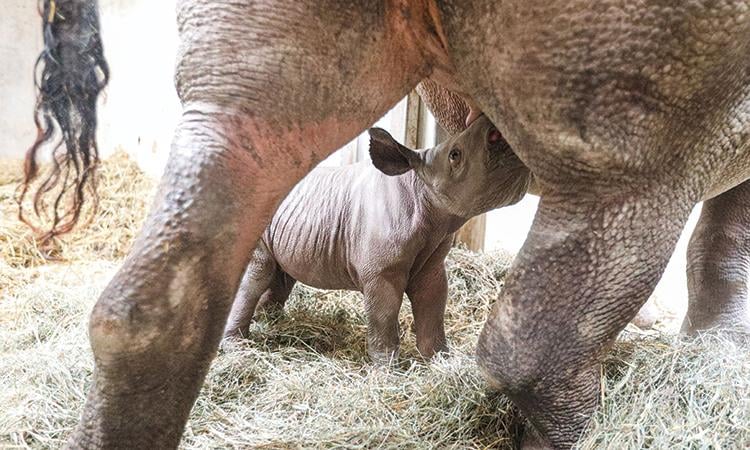
Christmas Eve 2019 brought a special gift to the world when a rare eastern black rhino was born at 5:40 a.m. at Lansing’s Potter Park Zoo.

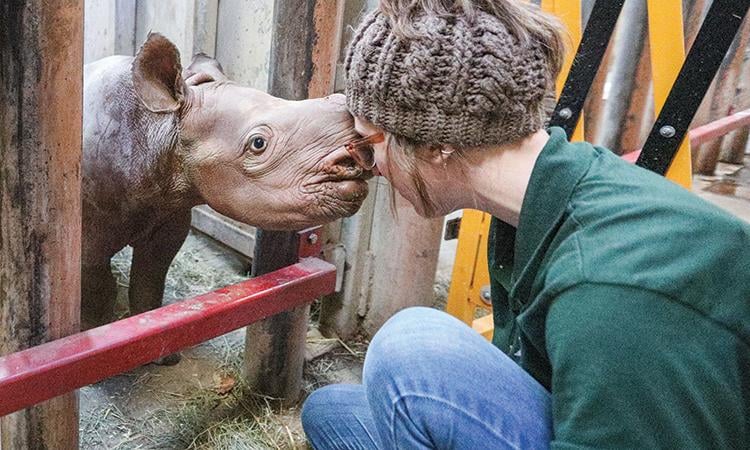
Doppsee, the calf’s mother, had been closely monitored during her 15-month long pregnancy by a dedicated team of animal scientists that included MSU veterinarians and students. The baby calf—a boy named Jaali, pronounced “Jolly”—stood within the first few hours of being born and has since stayed close beside mom in the protected pen at the zoo.

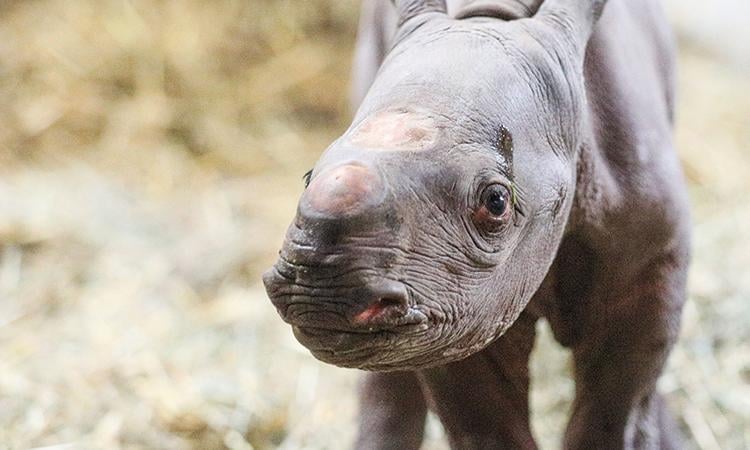
Jaali close up of face
Jaali nursing
Jaali touching noses with zookeeper
Jaali close up of face
Jaali nursing
Baby Jaali has not yet begun to grow his horn, which will be composed of keratin, a protein found in human hair and nails, as well as calcium and melanin.
Jaali began nursing a mere three hours after his birth.
Like mother, like son. Jaali affectionately goes nose to nose with a zookeeper.
Baby Jaali has not yet begun to grow his horn, which will be composed of keratin, a protein found in human hair and nails, as well as calcium and melanin.
Jaali began nursing a mere three hours after his birth.

01 / 03

Valued veterinary experience

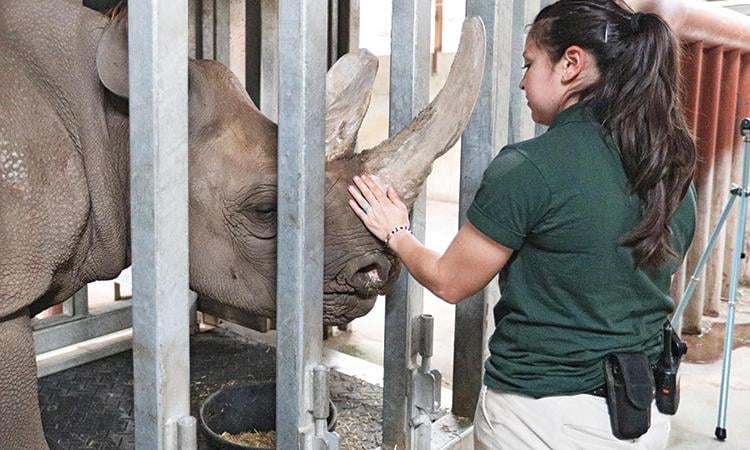
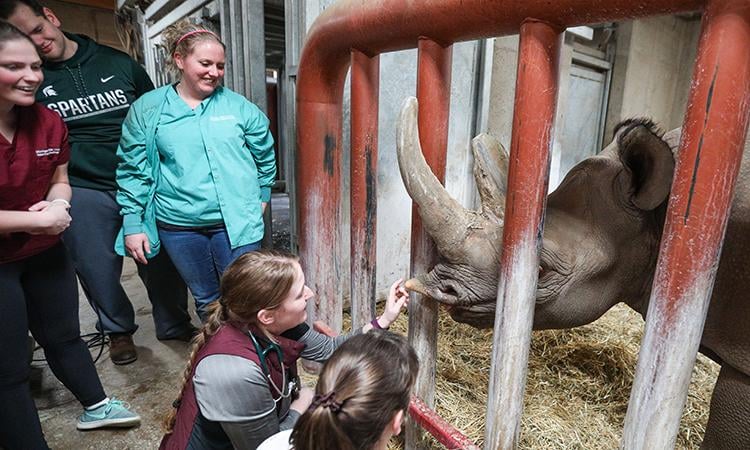
Caregivers report that Doppsee, unlike most of her breed, has a docile and gentle disposition that allows zookeepers to work closely with her, providing opportunities for MSU’s veterinary medical students to observe physical exams, blood draws and ultrasound skills.

“Collaborating with Potter Park Zoo is a wonderful educational experience, not only for our veterinarians, but also for our veterinary medical students,” says Julie Strachota, clinical instructor for MSU’s Department of Large Animal Clinical Sciences and resident for the Large Animal Theriogenology Service. “I never would have expected that I would be doing transrectal and transabdominal ultrasounds on a black rhino.”

Doppsee interacts with MSU Veterinary student
MSU veterinary medical instructors and students interact with Doppsee
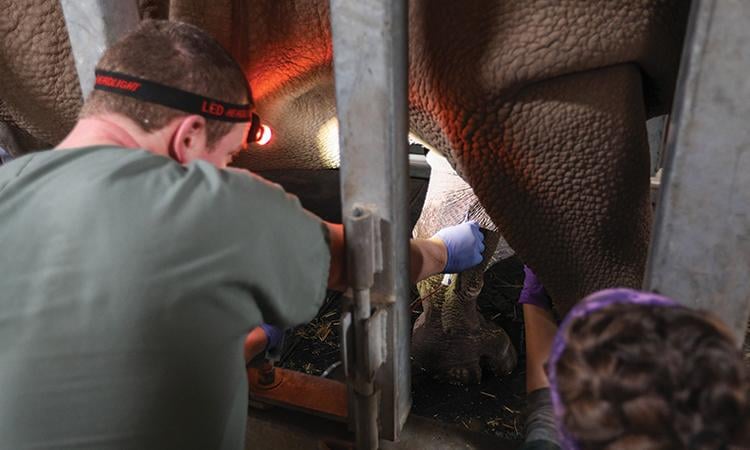
MSU's Dr. Eustace drawing blood from Doppsee's leg
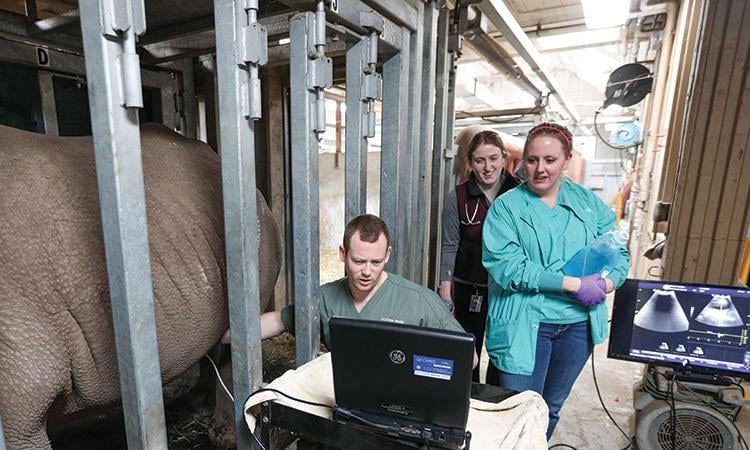
MSU's Dr. Eustace conducting an ultrasound on Doppsee with zoo staff looking on
Doppsee interacts with MSU Veterinary student
MSU veterinary medical instructors and students interact with Doppsee
Doppsee was a surprisingly agreeable mother-to-be throughout her multiple health exams.
Doppsee, the 2,800-pound mother of Jaali, enjoys human interaction.
Dr. Ronan Eustace draws blood from Doppsee’s leg.
Dr. Ronan Eustace, seated, conducts an ultrasound exam of the expectant Doppsee, as zoo staff look on. He is the director of animal health for Potter Park Zoo. He’s also an adjunct professor at MSU.
Doppsee was a surprisingly agreeable mother-to-be throughout her multiple health exams.
Doppsee, the 2,800-pound mother of Jaali, enjoys human interaction.

01 / 04

University Advancement

  • Mission
  • What We Do
  • Careers
  • Student Opportunities
  • Staff Directory

Alumni

  • About
  • Connect
  • Serve
  • Sparty
  • FAQs

Giving To MSU

  • Campaign
  • Ways to Give
  • Gifts in Action
  • Reasons to Give
  • Opportunities to Support

Spartan Stories

  • All Stories
  • Spartan Magazine Current
  • Spartan Magazine Archive
  • Submissions

Contact Us

(517) 884-1000

Email

univdev@msu.edu

Address

University Advancement 535 Chestnut Rd. Room 300 East Lansing, MI 48824

Follow Us

  • Visit our Facebook page
  • Visit our page on X
  • Visit our Instagram page
  • Visit our LinkedIn page
  • Visit our YouTube page

If you're having accessibility issues, please let us know.

  • Contact Information|
  • Site Map|
  • Privacy Statement|
  • Site Accessibility|
  • Call MSU: (517) 355-1855|
  • Visit: msu.edu|
  • Notice of Nondiscrimination|

SPARTANS WILL|© Michigan State University|

The veterinarians and zookeepers monitored Doppsee and her fetus weekly, providing opportunities for MSU’s veterinary medical students to participate in a rare and extraordinary learning experience. Most importantly, they ensured that she and her baby calf were kept safe, happy and healthy.

“Being able to get this hands-on experience is invaluable to me, as Doppsee is a species I am not able to work with often, so this experience continues to help me learn more about what it means to be a veterinarian,” says Bridget Walker, a third-year veterinary medical student.

Ronan Eustace, adjunct professor at MSU’s School of Veterinary Medicine and director of animal health at Potter Park Zoo, mentored veterinary students during summer sessions and oversaw the regular visits.

“Dr. Eustace always welcomes us to bring as many students as we can to work with the animals at Potter Park Zoo,” says Strachota. “During one of our ultrasound examinations, one of the senior students commented that it was ‘the best day of veterinary school.’ What the zoo is doing for our veterinary curriculum is invaluable.”

Critical conservation effort

While important to the pregnancy, the ultrasounds and blood tests on Doppsee provided more than imaging of her baby. Black rhinoceroses are critically endangered, with fewer than 5,500 remaining in the wild and 60 in protected environments.

Doppsee carries valuable genetics in the captive population of eastern black rhinos. The more these genetics spread, the greater chance there is of preserving the global population of black rhinos.

With the help of Monica Stoops, lead scientist of Omaha’s Henry Doorly Zoo and Aquarium, zookeepers and veterinary staff were able to develop an understanding of Doppsee’s hormone levels, estrus cycle and behavior. Doppsee, and the valuable data gathered about her cycle and pregnancy, contributed to several research studies. These studies will provide valuable information on black rhino reproduction—information that cannot be obtained from wildlife populations.

“If we can maximize reproductive success in these captive populations, then they may become sustainable—and that’s the goal,” says Eustace.
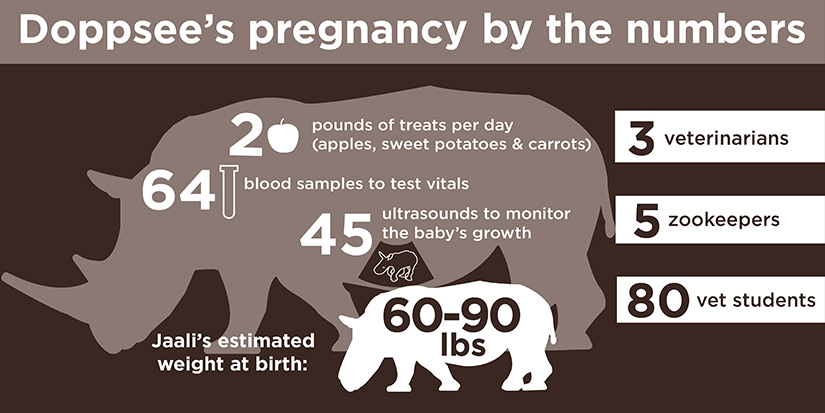
Doppsee's pregnancy by the numbers, 2 pounds of treats per day (apples, sweet potatoes & carrots), 64 blood samples to test vitals, 45 ultrasounds to monitor the baby's growth, 3 veterinarians, 5 zookeepers, 80 vet students, Jaali's estimated weight at birth: 60-90 pounds