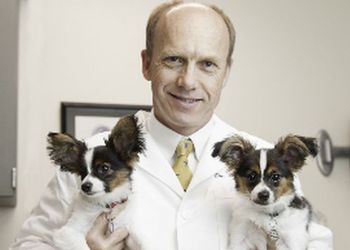
Scientists have new insight on an eye disease that affects papillon and other dogs and could lead to a better understanding of some human disorders, thanks to the Donald R. Myers and William E. Dunlap Endowed Chair in Canine Health in MSU’s College of Veterinary Medicine.
The endowed chair is held by Dr. Simon Petersen-Jones, professor of Comparative Ophthalmology, whose lab has been making pioneering discoveries in research on inherited retinal diseases in dogs.
Recently, they discovered a gene mutation for a form of progressive retinal atrophy (PRA) that leads to blindness in dogs with no known treatment. This finding is expected to provide new insights to help researchers understand the disease, provide early detection and move toward prevention or even a cure.
Human Health Could Benefit
In addition to helping dogs with PRA, the identification of what researchers named the PRA Type 1 gene mutation can help identify candidate genes for human disorders. “We hope to save vision—for dogs and for humans,” says Petersen-Jones. “This research will improve our understanding of retinal degenerations and may open the door to the development of new treatments in humans as well as dogs.”
Petersen-Jones has been a past recipient of National Institutes of Health research funding and new applications are in the pipeline to NIH based largely upon research results obtained via funding from the Myers-Dunlap Endowment for Canine Health.
The Myers-Dunlap Chair plays a key role in developing a world-class research program in canine health, notes MSUCVM Dean Christopher Brown. “The chair serves as a research mentor and resource in the college, and we are tremendously pleased that the donors had the vision to also provide seed money from the endowment that is now generating the crucial preliminary data that will drive important new research to help treat retinal diseases in dogs with possible crossovers to human health,” he says.
Stopping the Disease in Papillons
Petersen-Jones’ lab used their findings to develop a DNA-based test to detect PRA Type 1 in papillon dogs with additional support from the Papillon Club of America and the cooperation of papillon owners and breeders.
For the first time, papillon dogs can be screened to determine if a dog is affected, unaffected or a carrier of the gene mutation. Because dogs must inherit the mutated gene from both parents in order to be affected, the knowledge allows breeders to safely breed PRA1-carrier dogs with genetically normal dogs. This prevents passing on the disease without restricting the available gene pool which otherwise could result in breeding away good traits or causing the emergence of a genetic problem for which there is no test.
“The cooperation of papillon owners and breeders and generous support from the Papillon Club of America and the Myers-Dunlap Endowment for Canine Health made this research possible,” says Petersen-Jones. “We were able to do a genome-wide association study to test more than 170,000 single nucleotide polymorphisms, which act as biological markers and help us locate genes that are associated with disease.”
A Jewel in Michigan
Petersen-Jones also serves as a surgeon in the Veterinary Teaching Hospital. Last fall he treated a tumor on the eye of a golden retriever named Annie, owned by Keith Crain, editor of Crain’s Detroit Business. In a subsequent column Crain wrote about the experience, he described Dr. Petersen-Jones as a “remarkably caring surgeon” and the hospital as “another jewel in our state that everyone should appreciate.”
He wrote: “Petersen-Jones and his wife, also a surgeon, moved from England to East Lansing simply because it was the best. A great tribute to the educational facility.”
Annie, by the way, has recovered and is well on her way to a long, happy life.
Memorializing a commitment to companions
Those who have loved and lost a pet realize the richness their companion brought to their lives. As an enduring acknowledgement of the human-animal bond, the Donald R. Myers and William E. Dunlap Endowed Chair in Canine Health was established by an MSU graduate and his partner. Two great pleasures for Myers (’50) and Dunlap were their dogs and MSU. They were often seen with their miniature Schnauzers at MSU football games.
They determined that an endowment, established in 1999, was a way for them to support MSU and to help advance the medical care of dogs. Dunlap passed away in 2003 and Myers died in 2008.