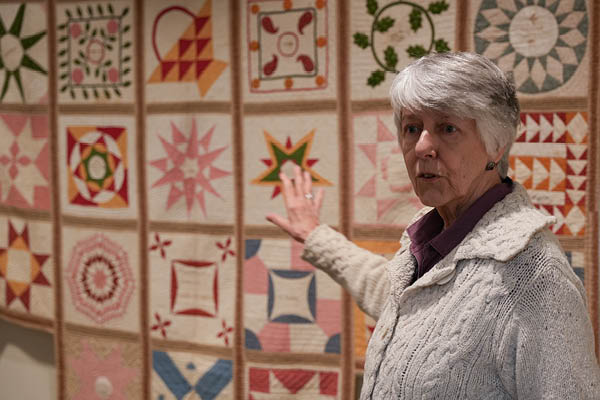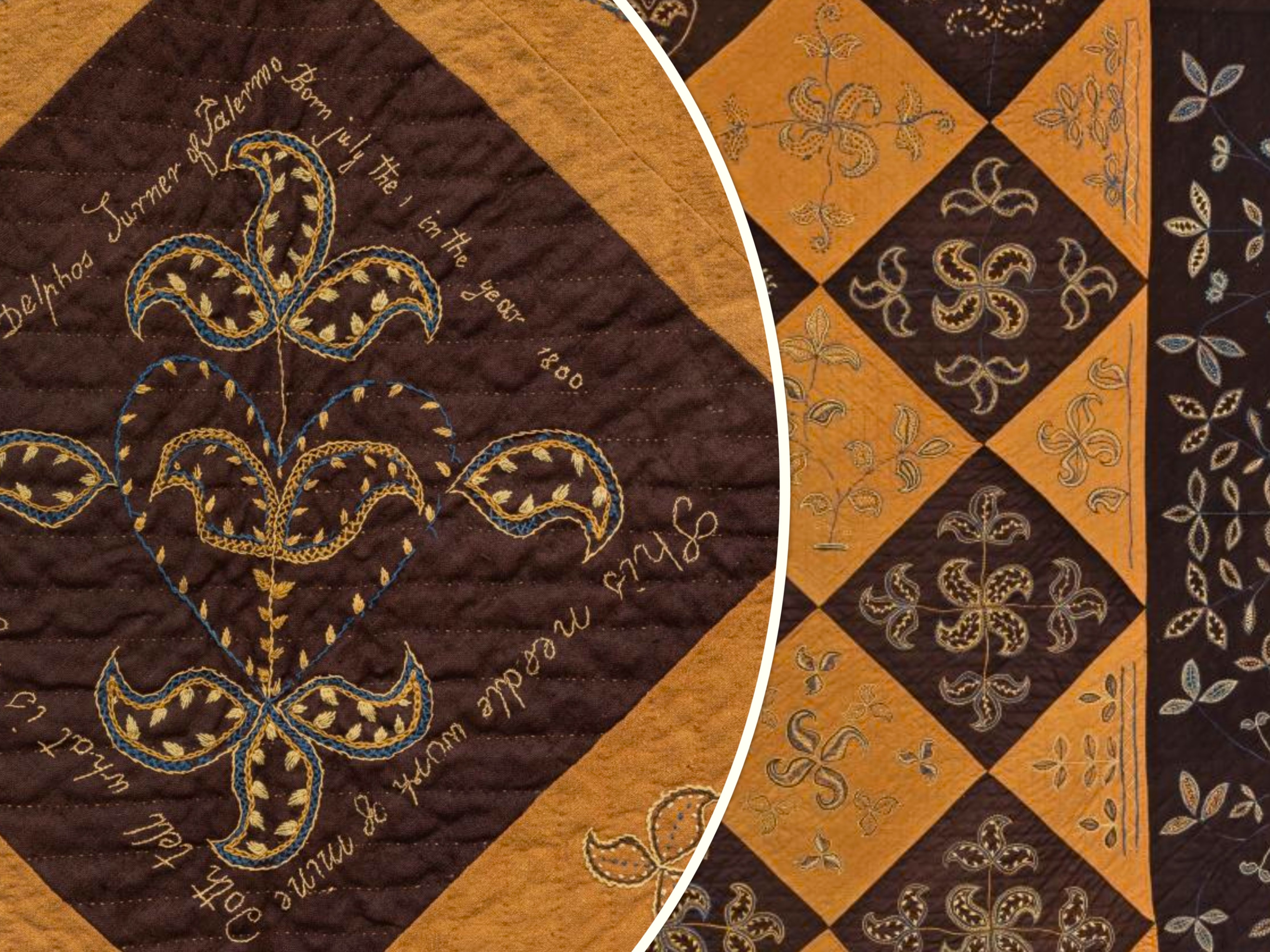
Not all 63 quilts in the Maine Historical Society’s collection came with a story. This one did. One of the oldest and remarkably well preserved, its hand-dyed wool fabric had lost none of its ardor since 1818, its stitching as resolute as the day it was made.
As Christine Force inspected the quilt, spread across a large table in the museum’s storage facility, she noted the deft craftmanship: a checkerboard of brown and ochre blocks flourished with a pale floral motif, and a circle of words laced at center—the quilt’s history immortalized by its precocious creator: This needle work of mine doth tell what is my name and ‘whare’ I dwell. Delphos Turner of Palermo Born July 1 in the year of 1800.
“It’s in extraordinary condition,” Force remarked. “We don’t know if it was her sheep that were shorn, but she cleaned, carded, spun, wove and dyed the cloth on her own to make that quilt. It’s a work of art.”
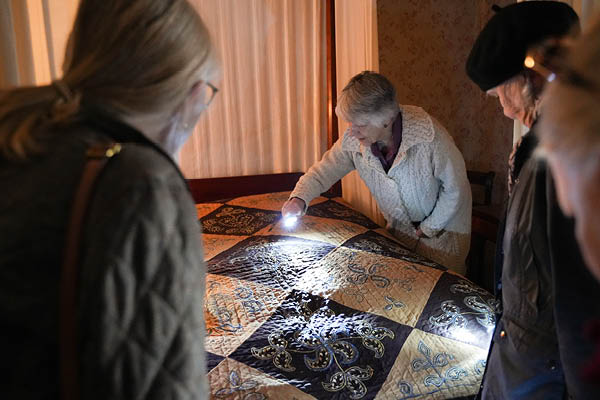
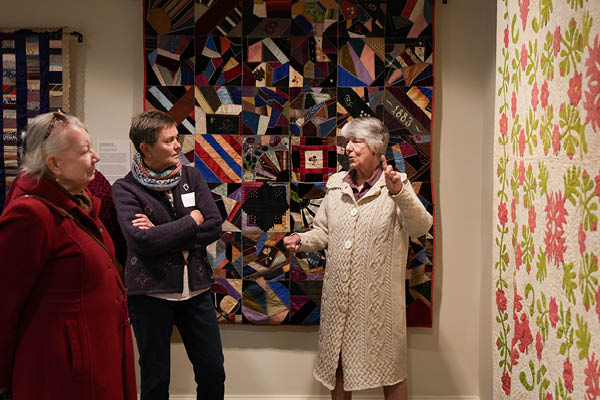
The Turner quilt was one of the few selected by Force for Stitches, a six-month exhibition exploring Maine’s 19th-century quilting heritage. From hobbyist to guest curator, Force embraced the opportunity, unexpected as it was. Her life has often unfolded similarly—surprises, detours and reinvention, all patched together with threads tracing back to Michigan State University.
Force’s Spartan journey started in 1972. She arrived in East Lansing from Massachusetts with a college degree and ambition, though, like many women, she was routed into a secretarial pool. That was fine for a time, but she needed more.
Taking advantage of free courses for MSU employees, Force completed a certificate in cartography and joined the Geography Department. She was part of the Spartan team that completed the 1977 Atlas of Michigan, the first comprehensive state atlas since 1873. The work demanded meticulous drafting, from pen-and-ink maps to hand-keyed type, instilling a manual precision she still relies on today.
She followed that unique achievement with another: earning her pilot license in 1976 as a member of the Winged Spartans.
“Everybody has skills that you never know you have until there’s an opportunity to bring them out,” Force said. “MSU has everything.”
Force spent the next two decades working for the State of Michigan in transportation and commerce before returning to campus in 2000 in the Office of Intellectual Property, now MSU Technologies.
Again taking advantage of the course catalog, she earned a master’s degree in Apparel and Textiles at the age of 58—a high achievement for someone who once described herself as a “mediocre student.” Drawing on relationships she had built at MSU, Force flourished in the program and was inducted into the academic honor society Phi Beta Kappa.
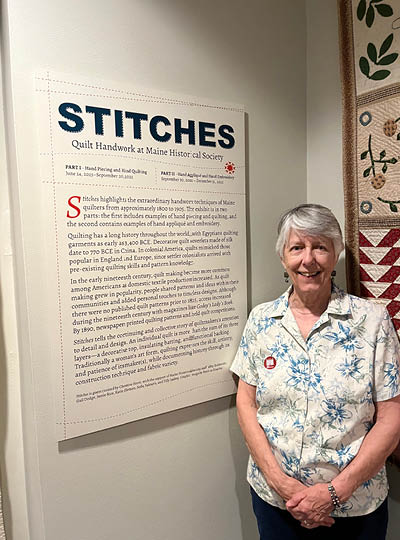
“I was always a late bloomer,” she said. “I didn’t have a clue in undergrad. I didn’t have an advisor, I switched majors a bunch, dropped out, came back. MSU was where I was truly able to get some academic grounding. It was a big learning lesson late in life that you don’t need to do it all alone.”
Force retired in 2010. A “New Englander at heart,” she moved to Maine and took another surprising turn, joining a quilting chapter and rising to vice president within a year, despite limited experience. It wasn’t entirely new territory. Her grandmother taught her to sew in eighth grade, giving her confidence to make her own clothes—garments she then patched together into her first quilt, which she still owns today.
But the chapter spoke a different language. Hems, darts and ease gave way to less-familiar terms like batting, binding and piecing.
“I had to learn a whole new vocabulary and way of doing things. But I found my people. A great group who had been quilting for a long time. They embraced me,” Force said. “We all love fabric. We all have a stash. The joke is that the person who dies with the most fabric wins.”
Stitches, which ran through Dec. 31, 2025, helped Force take her hobby in a new, exciting direction and proved a hit for the historical society. Her work documenting the collection is ongoing, and she recently joined the American Quilt Study Group, connecting with others dedicated to researching and preserving historic quilts.
Whatever the next chapter, Force is ready.
“I’ve had a very patchwork life. Things go down, we make them go up again. There’s never been a plan,” Force said. “You need to follow your passions. You never know what opportunities will present themselves. You need to be open to the possibilities. MSU was a godsend in terms of how it broadened my world.”
Photos courtesy of the Maine Historical Society