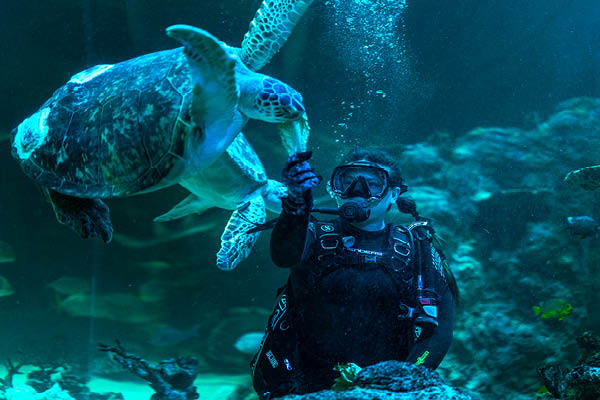
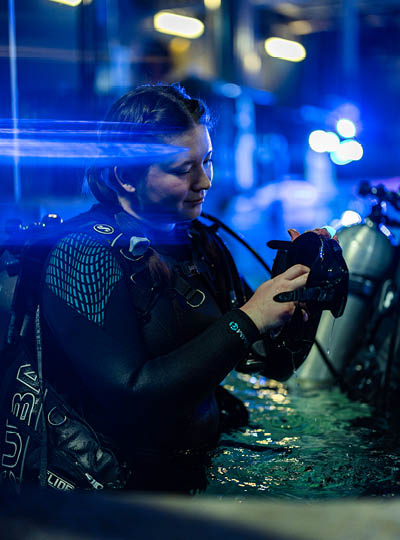
There is a certain peace at the bottom of 120,000 gallons of saltwater. As Dana MacCallumMhor sinks under the surface, the world fills with the soft rumble of far-off filters, punctuated only by rattling bubbles and the hypnotic hiss of her regulator. It’s a serene space.
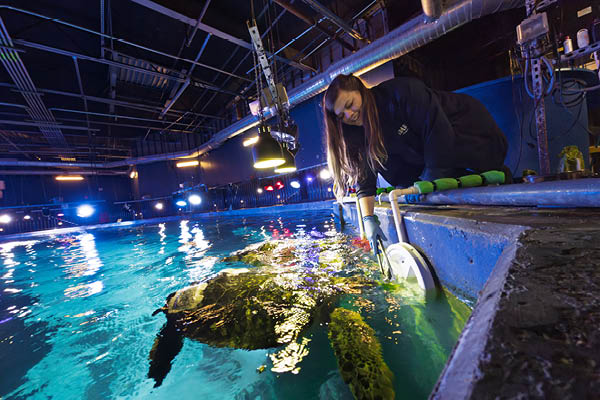
It’s easy to lose yourself here. Before long, Benson, one of two green sea turtles in the tank, swims over to say hello. Most of the creatures keep their distance. The turtles, not so much. “They remind me of cats,” says Dana. “The turtles are always really interested in us. They’re curious.”
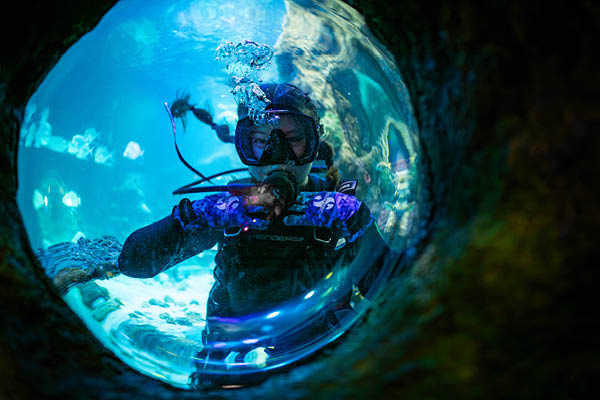
This is the best part of Dana’s week. At 76 degrees, the water is cooler than it seems. Even in her wetsuit, that initial plunge is a shock—a great chaser to the two cups of coffee she had for breakfast. They always dive in pairs, but nearly the whole team is engaged. One person stays up top, a liminal lair with salt-stained rafters and backstage lighting. Another watches from the gallery below. They communicate with hand signals and walkie-talkies.
Sea Life Michigan in Auburn Hills is the largest aquarium in the state. The main attraction is the tropical ocean exhibit, home to over 500 creatures—everything from Benson and Carr, the two sea turtles, to nurse sharks, stingrays and more. Inside the tank, Dana has a job to do, scrubbing hardscapes, wiping the acrylic and checking the animals for injury. When the hour-long dive clock expires, she surfaces, ready to talk.
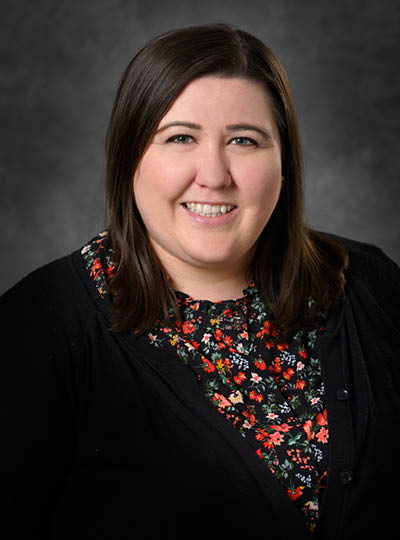
Dana is a soft-spoken 25-year-old, already nearing four years on the job after graduating from Michigan State University in 2022 with a degree in fisheries and wildlife. She has a deep passion for animals and the environment and exudes a sense of never-ending wonder. It’s not lost on her that what she does is fantastical and rare, especially in Michigan.
“This is the coolest job in the world,” she says. “I never saw myself being lucky enough to do this and make it a career. It’s extremely competitive across the aquarium industry, and these jobs are very limited in Michigan.”
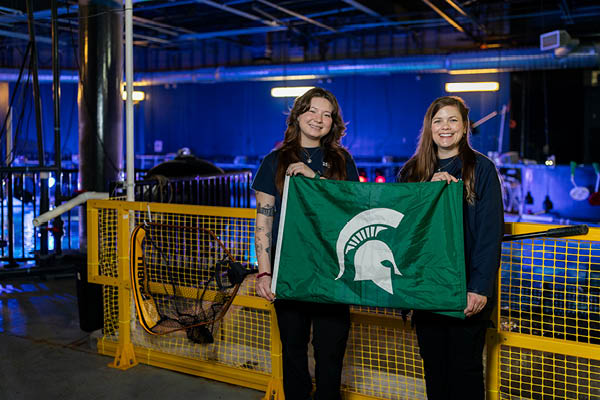
Sea Life employs not just one, but two graduates from Michigan State. Lauren Grauer has been there nearly since the aquarium first opened in 2015. Fresh out of MSU with a degree in zoology, she started as a part-time husbandry assistant, moving to a full-time aquarist, then senior aquarist, and now curator, since late 2022.
“I never thought I would get to stay in Michigan,” says Lauren. “There wasn’t a lot of work for me here. I assumed I would have to move, but Sea Life opened the same year I graduated, so it was perfect.”
Lauren has a disarmingly endearing love for her work. She speaks about both the people and the creatures under her care with warmth. The small details matter: she quizzes her team on the Latin names of animals to reinforce connections between seemingly unrelated creatures. Her favorite is turbo petholatus—snails. “They’re just so weird,” she says. “They’re cleaner-upper animals. They eat the problematic algae you can’t scrub off. And they’re just cute.”
For many, even with experience, a job like this, in a place like this, can feel little more than fantasy. For Dana and Lauren, it once did. Michigan State made it possible.
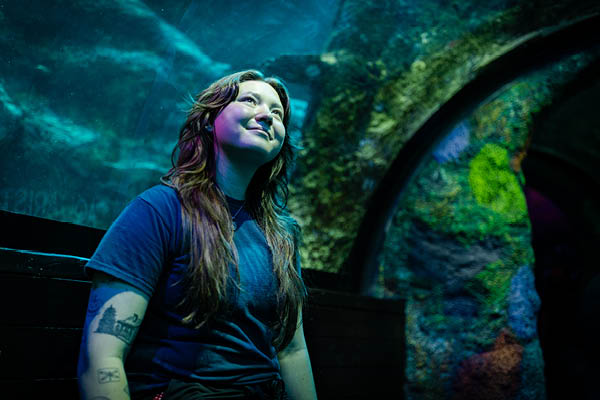
The ecological inclination
There she stood, in knee-deep water, chest waders and rubber boots holding back the Red Cedar as it cut through the heart of MSU’s campus. It was her turn. Dana stepped forward, lifting from the river a smallmouth bass caught by electrofishing.
Electrofishing is introduced early in the fisheries and wildlife program. Using a mild current, fish are temporarily stunned, allowing researchers to collect data before releasing them.
Three weeks earlier, Dana had arrived on campus carrying the familiar anxiety of a first-year student, still half uncertain that she was in the right place, doing the right thing. Now, she was standing in a river, holding a fish … and she was in class.
“I just remember thinking: this is what I want to do,” she says. “And that was just one of my classes. In that moment, I felt so lucky to have that confirmation of what I was doing.”
Growing up, Dana’s parents were not overly outdoorsy, though that didn’t stop her. Her connection to the natural world blossomed in bits, swimming in the Great Lakes, sleeping under the stars. As she grew, so did her concern—it needed to be protected, and she needed to do it.
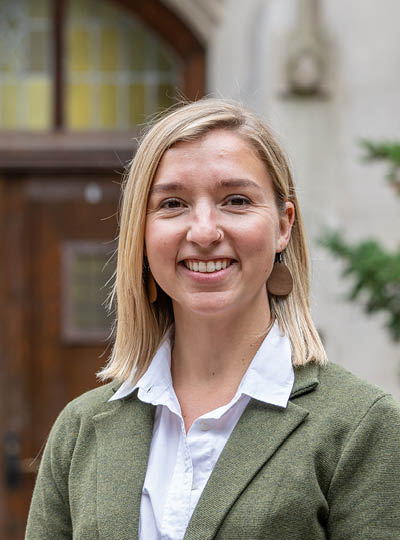
At MSU, she joined the Residential Initiative on the Study of the Environment (RISE). The living-learning community, with its focus on the environment and sustainability, was a perfect fit. When she met RISE students in the fisheries and wildlife program, she started to see herself there, too.
Dana’s experience is common, says Jorhie Beadle, ’15, Ed.D. ’25, interim director of RISE. Environmental passion is just an entry point. Students have a range of backgrounds, everything from science and agriculture to engineering, business and healthcare.
“A lot of people are still finding their place and purpose. It’s a great way to cross-pollinate ideas,” says Beadle, who is also an alum of the program. “It’s a sense of belonging. That community piece is pivotal. In order to tackle the problems of our time, things like climate change, we need lots of different types of thinkers.”
RISE students participate in a variety of sustainability projects, including composting programs, a rooftop honeybee hive and cooking workshops. Chief among those is the Bailey GREENhouse & Urban Farm, where students learn about food systems, safety and soil science. Food grown there is harvested and delivered to the dining halls at Brody Square.
“Experiential learning has more staying power because they’re physically engaged in it,” Beadle says. “Their ability to synthesize and recall knowledge is just far more possible than if they’re just reading it in a classroom. It’s a more didactic way of learning.”
For Dana, that was the key. From the greenhouses of RISE, to pinning insects in entomology or midnight fishing in Sault Ste. Marie, she thrived with a tactile education.
And it started with a smallmouth bass in the Red Cedar her first month on campus.
“That’s one of my favorite parts of MSU, because all my classes were like that,” Dana says. “Anyone can learn anything on paper or through lectures, but seeing it all in real life helps make those connections. Getting hands-on experiences makes it a lot more valuable.”
The talent triangulation
Lauren arrived at Fort Custer State Recreation Area just before sunset and collected her telemetry kit. Moving carefully through the wild margins of Eagle Lake, she scanned for a signal that meant an Eastern box turtle was nearby.
Her first time using the equipment, Lauren found just one turtle in six hours. But she was getting better. Over the next four hours, she located six. For each, she recorded the turtle’s behavior and surroundings along with other location and weather data.
It was the summer of 2014, and, in less than a year, this area would be reduced to a charred landscape in a prescribed burn experiment. Lauren’s work as a student intern in the months leading up helped MSU researchers understand turtle movement and protect populations.
“I never thought I would even consider being a field biologist in the future,” Lauren later wrote in a paper about the internship, “but after this experience, I’d jump back in my boots and get them dirty again.”
By then, Lauren was heading into her senior year at MSU, having chosen a major just a year earlier. She had switched from pre-veterinary to nursing, briefly considered journalism, and then found herself caught between zoology and engineering. Zoology won.
Her internships helped sharpen her focus. A summer at an Ohio wildlife park introduced her to working with large mammals, but it didn’t quite stick. Fieldwork with box turtles did. The next summer, she combined the best of both worlds, working with reptiles and amphibians at the Virginia Aquarium.
“We encourage our students to get out there,” says Sarah Whitaker, Ph.D. ’25, Director of Experiential Learning in the College of Natural Science. “We want them involved in internships, in research and faculty projects, so that they’re really engaging and learning more deeply.”
Just as important, Whitaker says, is what those experiences rule out. Not every path fits, and discovering that early can be just as valuable. Lauren needed just two pre-veterinary classes to see she was headed in the wrong direction, and just a few weeks at the wildlife park to reconsider that path.
“The biggest thing students can do to benefit from their experiential learning is to reflect on their experience afterward,” Whitaker says. “That’s where meaning is made and where you find value. Learning comes from reflection.”
Lauren left MSU with a strong direction and important insight from Integrative Biology Professor Dr. Richard Snider, who helped build the NatSci internship program and took pride in MSU’s ability to help students land in competitive careers. He pushed Lauren to see the field clearly. It wasn’t enough to be interested. She needed to be ready.
“Without him, I don’t think I would have had the concept of how competitive this was and how much work I needed to do to get into the field,” Lauren says. “Make friends with your professors and advisors. Talk to people doing the job you want. A lot of it is getting your foot in the door, gaining experience and knowing what it takes to get there.”
The conservation manifestation
Lauren was 5 years old when she first visited SeaWorld. At that age, memory is malleable, easily blurred or reshaped, but certain moments take hold. For Lauren, that was a core experience. For everything she’s forgotten about that trip, she remembers one thing: the orcas. “I cared a lot about orcas after that,” she says.
It’s something she sees every day at Sea Life. When children round the corner into the tropical ocean habitat, it’s often Carr, the green sea turtle, they see first, wedged into his resting spot beside an ornate mermaid head. Kids press in close, squealing at the chance to be just inches away.
“It gets me every time,” Lauren says. “They’re going to care about sea turtles a lot more now. The work we do is important. It gives people a chance to experience animals they wouldn’t see otherwise, and, hopefully, care about protecting them.”
Sea Life is one of just six institutions in Michigan accredited by the Association of Zoos and Aquariums—and the only aquarium among them. That distinction carries real obligations to promote conservation, research and education.
Those efforts take many forms.
The Florida Reef Tract Coral Rescue is a large-scale initiative to save endangered coral from tissue loss disease. Healthy fragments are preserved at Sea Life to protect genetic diversity until a cure can be found. The aquarium currently holds nine species of Atlantic coral for the project.
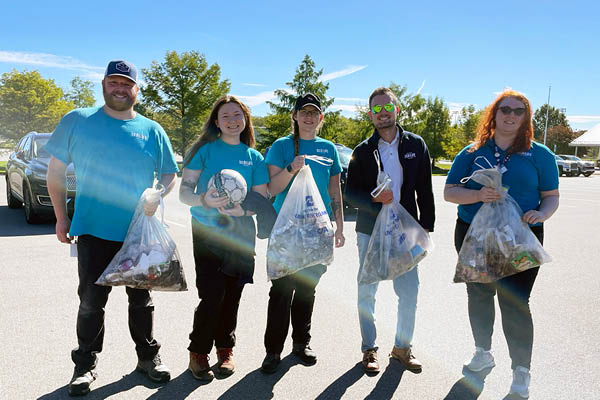
Closer to home, lake and river watershed cleanups bring together staff and volunteers to clear debris from local waterways. Between April and October last year, Sea Life hosted 12 cleanups, removing more than 1,100 pounds of waste—its largest total to date.
Other work includes partnering with the Michigan DNR to repopulate lake sturgeon and rehoming illegal aquatic species confiscated by the U.S. Fish and Wildlife Service. Each of the aquarium’s five aquarists leads a conservation program.
“The reason we all work with animals is because we have connections and experiences that make us care about nature,” Lauren says. “When you care about something, you want to protect it, and you want the next generation to appreciate it and protect it, too. Our staff wants to leave the world a better place than we found it.”
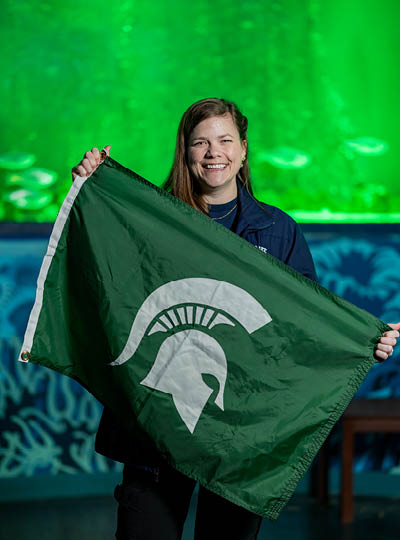
Before becoming curator, Lauren led the Blanding’s turtle Head Start Program. She handed that responsibility to Dana, who was her first hire. Dana was “exactly the type of person” they look for, Lauren says. Her fisheries experience and infectious passion for Michigan species made her stand out. Being a Spartan helped, too.
“Lauren has taught me so much,” Dana says. “It was all very intimidating at first, but she walked me through it and taught me everything there is to know about animal husbandry. She taught me how to be successful working at an aquarium.”
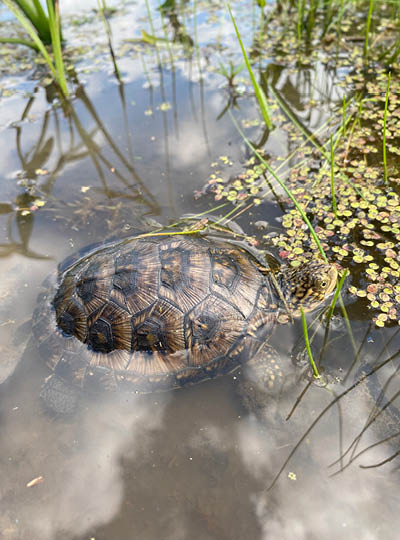
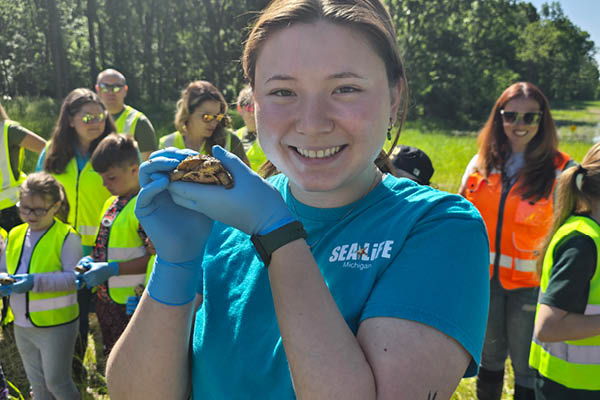
Now, the Head Start Program thrives under Dana’s care. Blanding’s turtles, a protected Great Lakes species, face ongoing population decline due to human impact. Sea Life raises orphaned hatchlings before releasing them back into the wild. The 25 turtles currently in her care arrived in August. This spring, they will become the fifth group released since she took over the program.
Before release, each turtle must pass a health check, weighing over 40 grams with a strong carapace. Dana feeds them twice a day, tracks their growth, observes behavior and gives them fun names—this group is fruit-themed: Strawberry, Fig, Guava, Banana.
“It makes me happy knowing I’m playing a role in their survival, Dana says. “I want to help bring their numbers back up so one day they can be taken off the endangered species list.”
Dana will happily talk about Blanding’s turtles all day. Or potbellied seahorses. Or chain catsharks. Or her favorite, the longhorn cowfish—his name is Coleslaw. “He loves to come to the surface when I approach the tank and blast jets of water at me. I like to tell myself he’s excited to see me,” she says. “The more you work with these creatures, the more you can see their personalities, the more you can tell how unique they all are.”
For both Lauren and Dana, nothing makes the job more special than meeting a child eager to talk about what they’ve seen. In those moments, they see themselves at that age, precocious, excited, ready to make a difference—just waiting to be activated.
“The kids I meet here are like mini-marine biologists,” says Dana. “They ask questions nobody else asks. I love hearing those passionate questions from a kid so interested in this work and being able to answer them.
“Michigan State really helped prepare me for this. Without the hands-on experiences, without putting myself out there and making connections, I wouldn’t have found this career—the one I used to dream about.”