How MSU researchers are joining forces to meet the most pressing health care challenges head-on.
By: Devon Barrett
If you’ve been a human in this world long enough (and, since you’re reading this, we assume you are a human, and you’ve been one for at least a little while), you’ve most likely, at one point in your life, experienced a change in your health or the health of a human or animal you care about, that was so abrupt that it felt like it happened overnight.
Is it possible to pick up a virus that takes you from 100% one day to waking up feeling like a shadow of your former self the next morning? Absolutely.
And is it possible for a chronic or life-changing condition to appear a month after receiving a clean bill of health? Of course.
But most of the time, something walked so that your pesky influenza virus could run.
Something walked so that Parkinson’s or Alzheimer’s or cancer could run.
It can be scary to imagine all the biological, social and environmental factors that, unbeknownst to you, are impacting your health.
But MSU researchers aren’t scared.
Scientists from across the university have been steadily walking toward novel, thoughtful, exceptionally collaborative approaches to health, and all of its contributing factors, for years—decades even.
And now, well, it seems like the perfect time to take off at a run.
We're on the same team
Health and Medicine
MSU is a big place. And it would be strange and potentially impossible, statistically speaking, if certain areas of research didn’t fortuitously overlap with other areas of research, to such a degree that big, multidisciplinary partnerships would start to form.
In all of these collaborative efforts, the contributions of researchers from science, engineering, agriculture and medicine are just as mission-critical as the contributions of experts from communications, social sciences, business and the humanities. No contribution is too small. Every single one moves the team one step closer to a breakthrough.
Together, they’re churning out incredible innovations.
FUN(DING) FACT!
Last year, MSU managed $992M in research expenditures. $474M was funded via federal agencies like DHHS, the National Science Foundation, and the USDA.
The magnificent seven
More than 300 MSU researchers from seven colleges work under the enormous umbrella of AgBioResearch. Their primary mission: to discover economically feasible, scientifically based solutions to global challenges that impact our food, our water, our environment and, by association, our health.
High IQ
If the work of AgBioResearch keeps us fed, hydrated and largely protected from existential threats to our natural resources and ecosystems, the Institute for Quantitative Health Science and Engineering, aka IQ—a collaboration between the Colleges of Engineering, Human Medicine and Natural Science—is here to fill in the other gaps: How can we preemptively preserve health? And until we figure that out, how can we diagnose disease earlier and with more accuracy? How can we deliver treatment more precisely? And how can we use our collective expertise to make the field of medicine as we know it, better?
We're finding intersections
We all know at this point that there is so much more to treating or curing illness and maintaining health than just making a quick trip to the doctor.
We also know that those things happen at the intersections: where health meets agriculture, where health meets engineering, where health meets communication and social science and our relationships with people, pets and the environment we share.
At all of these points of connection, there are possibilities for new approaches to living healthier lives, preventing illness and treating it more effectively if it does happen.
They live in our environment. They drink our water.
Dr. Kurt Zinn, the Hickman Family Endowed Chair in Oncology and a professor in the MSU College of Veterinary Medicine, is a veterinary researcher by training. But as a member of IQ, with joint appointments in the College of Human Medicine and the College of Engineering, he understands just how much overlap there is between diseases that affect humans, and diseases that affect the companion animals (like cats and dogs) that they share their lives, homes and daily routines with.
Bladder cancer is one of those diseases, and Dr. Zinn and his team are working toward clinical trials of radioisotopes that can identify—and eventually deliver more effective treatment to—this type of cancer in both dogs and humans.
The tiniest robots you’ve ever (not) seen
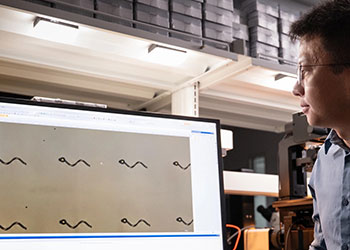
Dr. Jinxing Li shows a magnified view of the TriMag microrobots.
Dr. Jinxing Li, an assistant professor in the MSU College of Engineering and principal investigator in IQ, alongside a team of fellow researchers from MSU, Henry Ford Health, and Arizona State University, has been working on a product that will change the tide of noninvasive, highly targeted therapy: the TriMag microrobot. The biodegradable, 3D-printed robot, which is smaller than a human hair and can only properly be seen through a microscope, will be capable of moving precisely through the body using magnetic fields and real-time tracking via advanced imaging, while delivering medicine, destroying tumor cells or performing procedures that would otherwise require tricky surgery.
ZOONOTIC/ZO-O-NOT-IC (adj.):
an infection or disease that is transmissible from animals to humans under natural conditions
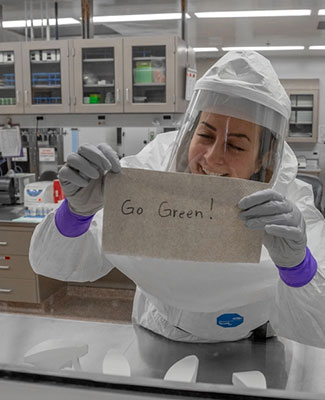
Virology Section supervisor Hannah Rawza shows her team's Spartan spirit from inside the VDL's biosafety level 3 (BSL-3) laboratory. Photo by Derrick L. Turner
Don’t worry: the MSU Veterinary Diagnostic Laboratory is on the case! During the recent outbreak of HPAI (Highly Pathogenic Avian Influenza, commonly known as “bird flu”), MSU’s quick action to address the virus’s jump from poultry to dairy cattle served as a model for testing, management and prevention of further spread through Michigan’s dairy and poultry farms—not to mention the humans who work on those farms. (And while the zoonotic virus didn’t end up jumping from livestock to humans in a significant way, a threat to the health of our food sources is as real as a threat to our own health.)
Small things making a big difference for people battling cancer
Cancer treatment takes a toll on the human body in a way that has many cancer patients wishing, simply, to “feel like themselves” again. Two unexpected innovations from MSU might be able to help.
A hydrogel to help people keep their hair was developed by professor Bryan Smith’s team in the MSU College of Engineering and the IQ. The gel, which would be applied during chemo, delivers vasoconstricting medicine directly to the scalp, restricting blood flow just enough to create a line of defense that prevents the chemotherapy drugs from taking over the follicles.
Meanwhile, the MSU Forestry Innovation Center is working with maple water. A concept currently under development by a multidisciplinary, multi-institutional team led by Jesse Randall, director of the Center in the College of Agriculture and Natural Resources, has shown that a healthy sip of the slightly sweet liquid helps maintain hydration. While not a new invention, for cancer patients who are struggling to stay healthy and hydrated through chemo’s rough side effects, the taste of water lightly infused with maple sap was more palatable than plain water, but less sickly-sweet to their altered sense of taste and smell (a chemo side effect) than fruit juice or a sports drink.
Helping people keep their voices
When you think of the College of Communication Arts and Sciences, your first thought probably isn’t “health care.” But the multidisciplinary teams in the Department of Communicative Sciences and Disorders are developing all kinds of ways to help people overcome communication challenges brought on by conditions like Parkinson’s or atypical parkinsonism—which can cause patients to take on a soft, breathy or hoarse voice.
Thea Knowles, a speech language pathologist, is leading a team that is investigating the efficacy of a handheld, easy-to-use speech amplification device that not only helps these individuals communicate, but also reduces the stress and burden they experience from not being heard.
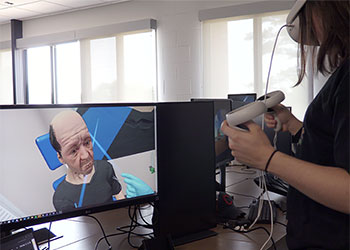
And in the Lip-Tongue-Larynx Lab—in partnership with the Games for Entertainment and Learning Lab—MSU experts are working on virtual reality technology that can simulate patient-provider interactions to better prepare medical students for specific medical scenarios or patient interactions that they may not encounter in a classroom or internship setting. One example is caring for patients who have undergone a tracheostomy or laryngectomy procedure. Practicing on virtual patients in a VR setting gives future medical professionals experience and confidence for the first time they work with a patient in a real clinical setting.
We're meeting people where they are
All over Michigan, people are benefiting from MSU’s health care expertise and innovation because MSU is meeting them where they are: in their communities.
The approach is two-pronged. Students who come to MSU as aspiring medical professionals are exposed to curricula and hands-on experiences that prepare them for the unique social or cultural needs and norms of the types of communities where they might someday practice.
Meanwhile, MSU researchers, clinicians and experts are finding new ways to advance and apply their work in ways that can make an immediate impact on the humans (and, in many cases, the animals) around them.
Financial support for growing families: just what the doctor ordered
Dr. Mona Hanna, associate dean for Public Health and C.S. Mott Endowed Professor of Public Health in the College of Human Medicine, has been a trailblazer for public health for years, most notably for her approach to the threats and barriers that stand in the way of babies and children receiving equitable care and growing up healthy. Her latest prescription? Cash. The Rx Kids program, founded and directed by Dr. Mona and funded through public-private partnerships, is the nation’s first-ever community-wide maternal and infant cash prescription program, which provides expectant mothers $1500 during pregnancy, and $500 per month during the baby’s first six or 12 months. The program originally launched in Flint, and, as of early 2026, had expanded to the Upper Peninsula, the City of Detroit and more than three dozen communities around the state. As the program continues to pick up steam and make an impact economically, a movement to bring the program to communities outside Michigan seems more and more likely.
Your zip code does not determine your health outcomes
The Charles Stewart Mott Department of Public Health is the first-ever named department at MSU, and the first to be co-developed and co-governed in partnership with the communities it serves. At the College of Human Medicine’s Flint campus, that means there is an outsized focus on health equity and social determinants of health—removing barriers to preventive care, improving access to healthy food, addressing racial disparities in mental health, and, of course, supporting Flint children who were exposed to lead.
There are a lot of rural areas in Michigan that have a histories of being medically underserved, too—including Indigenous communities and small towns across the northern Lower Peninsula and the U.P., where there may not be many options for primary or specialized care. The Leadership in Rural Medicine program is a way for medical students to get valuable hands-on experience in building positive, trusting doctor-patient relationships in these rural communities. And, through the program’s Indigenous Pathway option, students can learn from tribal elders and traditional healers to develop a deeper respect and understanding for patients’ cultures, and the health perspectives and traditions they may bring with them when they seek out medical care.
A trusted source of research-based health information
MSU Extension has been a hallmark of our land-grant institution since 1907, and, today, has a presence in all of Michigan’s 83 counties. Each county Extension office offers programs and services, tailored to the communities they serve, that make MSU expertise (on everything from vaccine information and education to resources for people living with chronic health conditions or struggling with substance use disorders) accessible to all. In a world where misinformation is increasingly difficult to spot, Michigan communities can rest assured, if the information is coming from MSU Extension, it is trustworthy and is backed by evidence gathered by MSU experts.
We're showing our Uncommon Will
Now that we’re running, what are we running toward?
MSU President Kevin M. Guskiewicz, Ph.D. has a few ideas, and with the help of leaders all across campus—and the input of the university community—those ideas have coalesced into an initiative called One Team, One Health.
“As health care and education evolve, we see the growing value of adopting a One Health approach that recognizes the interconnected health of people, animals and the environment,” says Guskiewicz. “This is the foundation of our One Team, One Health vision. By leveraging our strengths in biobehavioral research, our statewide Extension network and our collaborative spirit, we have a unique opportunity to help build a healthier future.”
Think of it this way: MSU is uniquely positioned to pull ahead in this race, and One Team, One Health is a checkpoint toward that victory. This effort unites our strengths and provides renewed energy, pushing us even faster toward solving the challenges that lie ahead.