Rugged off-trail trekking, searing heat, black flies and decomposed moose carcasses are among the hazards borne by dozens of citizen scientists each summer on a remote island in Lake Superior, all for the purpose of learning more about wolf and moose populations. “There’s no middle ground,” says Jeffrey Holden, ’83, MBA ’87. “People either like it, or they hate it.”
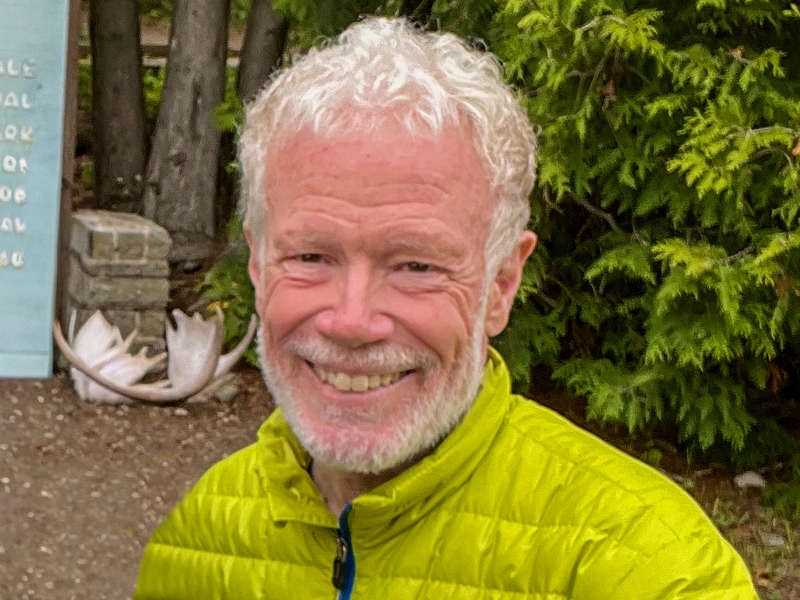
Holden loves it. So much so that he has returned to Isle Royale every summer since 2002 to take part in the Wolf-Moose Project, which began in 1958. Over the past six decades, scientists and volunteers have gathered valuable data on the interactions of moose and wolves that has augmented researchers’ understanding of predator-prey relationships.
Holden’s new book, “Dead Moose on Isle Royale: Off Trail with the Citizen Scientists of the Wolf-Moose Project,” published earlier this year by Michigan State University Press, is an account of the long-running study. Besides discussing the scientific import of the research, the book tells the tales of arduous work and tough conditions the citizen scientists endure to gather the data.
Researchers think the moose first arrived on Isle Royale around 1900, by swimming the 15-mile stretch of open water from the north shore of Lake Superior.
“Boaters between Minnesota or Ontario and the island’s north side can sometimes see moose swimming to the island even today,” says Holden.
The wolves first arrived via an ice bridge around 1949. Per a 2024 count on the 207-square-mile island, the wolf population numbered around 30, and the moose population was estimated to be 840. Wolves hunt moose in packs, but occasionally they pay a price for taking on the enormous creatures.
“A moose weighs about 10 times what a wolf weighs. They can and do kill wolves,” says Holden. “We find wolf carcasses with broken ribs, broken teeth—it’s not an easy life.”
An avid backpacker, Holden worked as a data consultant and manager for much of his career before coming across the Isle Royale study. “For the Wolf-Moose Project, we’re gathering data each year and there is always something new and different about it,” Holden says. “Also, science being what it is, the data we gather might be used by a completely different group of scientists, so we’re out in the field potentially helping other projects as well.”
The volunteer citizen scientists, many of whom return each summer, spend a week on the island, bushwhacking the backwoods looking for carcasses. “Even on the trails it’s tough hiking. I’d give it a four out of five in terms of difficulty,” says Holden. “Then throw in going off trail and 10 or 20 pounds of moose bones you’re carrying, along with a full pack.”
Now retired, Holden recently became president of the Wolf-Moose Foundation, the fundraising group for the Isle Royale study, which the researchers created two years ago to build long-term financial stability for the research. “The initial goal is to build an endowment so that the project is not dependent upon government grants,” he says.
According to Holden, one of the most important conclusions of the Wolf-Moose Project to date is how it informs our understanding of natural systems. “I’m oversimplifying, but there was a notion that nature was like a big machine. It might be complicated but if you can figure out the dynamics, you can figure out what will happen next,” he says. “This study has shown even if you have data for five or ten years, you can’t necessarily extrapolate into the future. Unpredictable but consequential events occur that change everything.”
Holden cites a canine parvovirus outbreak on Isle Royale in 1980—presumably brought to the island by a pet dog—that almost wiped out the wolf population. “These big things that change the dynamic happen frequently on Isle Royale,” he says. “You can explain things in retrospect, but you can’t predict them.”
Story by Chris Quirk